The post TROPAEOLUM appeared first on AmeriNursery.com.
]]>
Yes, it’s an annual. But Tropaeolum, commonly known as nasturtium, neatly bridges the gap between ornamental and edible, and may be just the plant that ties together the garden that’s created to offer both beauty and bounty.
For today’s – and tomorrow’s – gardeners who are demanding “purpose” in the landscape, nasturtium provides lovely color all season long, plus an unusual and striking garnish at the dining table. Both the flowers and the foliage are often used in salads, dressing up that plate full of greens. The foliage can also be prepared much like spinach, either fresh or cooked.
Name: Tropaeolum
Common name: Nasturtium
Hardiness: Annual
Mature height: 12 inches to 10 feet
Mature spread: 1 to 3 feet
Classification: Annual pot or garden plant
Landscape use: Grow in containers and allow to trail; use as a quick-growing groundcover or train the trailing variety up a fence or garden obelisk
Ornamental characteristics: Very showy, fragrant, funnel-shaped, fivepetaled flowers sport spurs; blooms range from red through orange to yellow and cream and grow to about 2.5 inches wide; rounded foliage; climbing and bushy, sprawling types are available
Some folks even eat the seed pods, although I once was warned to stay away from seeds, as a few questionable sources report they contain toxic elements. (Maybe that’s why Dad called them “nasty little nasturtiums.” On the other hand, he was given to wordplay, so you never know. He was known to pluck the plant, flower, stem and leaf, and munch it before he left the garden.) And in case you’re concerned about your pets, the ASPCA reports that there’s no evidence of toxicity to dogs, cats or horses.
The flavor varies slightly from garden to garden, but very slightly. (A neighbor, whose soil is similar to mine, offered some extra nasturtium and they were tangier than the crop I’d grown. Perhaps a different seed strain?) Washed flowers and leaves offer a subtle, peppery taste; certainly not overwhelming, but enough to spice up a salad. Some liken the flavor to a radish, although I’ve found them to be a bit wimpier than that. Stems may be slightly sweet at first, then the aftertaste is strongly peppered. I’ve only used nasturtiums in fresh salads, primarily because I’m an admittedly lazy cook. If it takes much preparation, I’m not interested.
So, that’s the table; what do nasturtiums contribute to the garden?
Phots: iStock | morgana3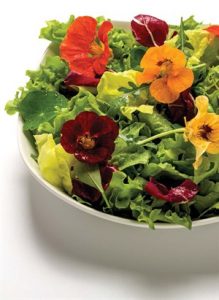
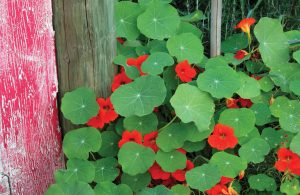
It’s hard to miss the brilliantly colored, showy blooms, offered in sunny colors ranging from red to orange to yellow, and sometimes cream. The funnel-shaped blooms, which have five petals and are spurred, sit atop rather long stalks. Many varieties have a spicy scent.
The unique foliage is rounded and presents itself like a parasol, with the petiole attached near the center of each leaf. Most leaves grow to about 3 to 4 inches round, but I’ve had several plants whose leaves have exceeded 5 inches – perhaps they were garden freaks.
There are quite a few varieties, most of them falling within two categories of growth habit: climbing types and bushy, sprawling types. It’s really just a matter of site conditions, as both types require similar care. Average to poor (!) soils are tolerated, and some afternoon shade is welcome in regions where summers tend to experience prolonged heat. The plants are not susceptible to significant insect or disease problems, although the occasional whitefly or aphid infestation may occur.
Nasturtiums grow quickly, offer color and rich foliage in container or garden settings, and provide a bit of Vitamin C, to boot. They’re the ideal starter plant for those who want more than aesthetics in the landscape. They’re plants with a purpose.
Cover Photo iStock | DaveAlan
The post TROPAEOLUM appeared first on AmeriNursery.com.
]]>The post REDESIGNED SURVEY REVEALS LATEST RESIDENTIAL LANDSCAPE DESIGN TRENDS appeared first on AmeriNursery.com.
]]>Sustainable and low-maintenance design are the top trends for residential landscape projects, according to the 2015 Residential Landscape Architecture Trends Survey conducted by the American Society of Landscape Architects (ASLA).
Landscape architects were asked to rate the expected popularity of a variety of residential outdoor design elements in 2015. The survey was fielded February 13 through February 27, 2015, with 581 responding. ASLA redesigned the survey for 2015 and introduced a new methodology to more clearly rank the popularity of different types of landscape projects.
Respondents expected the greatest demand for ecologically sensitive projects intended to preserve the environment, conserve water and reduce landscape maintenance.
Here are the top ten project types with the expected highest consumer demand:
- Native plants (85 percent)
- Native/adapted drought-tolerant plants (83 percent)
- Food/vegetable gardens (79 percent)
- Fire pits/fireplaces (78 percent)
- Low-maintenance landscapes (78 percent)
- Permeable paving (77 percent)
- Drip/water-efficient irrigation (74 percent)
- Rain gardens (74 percent)
- Lighting (72 percent)
- Rainwater/graywater harvesting (71 percent)
“Consumers care about designed landscapes that are attractive, easy to take care of and eco-friendly,” says Nancy Somerville, Hon. ASLA, executive vice president and CEO of ASLA. “The survey shows that homeowners increasingly see opportunities to improve the environment right in their own backyard.”
The top three most popular outdoor design elements include fire pits/fireplaces (78 percent), lighting (72 percent) and grills (63 percent). The top landscape and garden elements include native plants (85 percent), food and vegetable gardens (79 percent) and low-maintenance landscapes (78 percent). Pergolas (51 percent), decks (45 percent) and fencing (42 percent) are expected to be the most popular outdoor structures.
The hottest sustainable design elements include native/adapted drought-tolerant plants (83 percent), permeable paving (77 percent) and drip/water-efficient irrigation (74 percent).
Forty percent of respondents noted that the most popular outdoor recreation amenities for 2015 will include spa features—hot tubs, Jacuzzis, whirlpools, and indoor/outdoor saunas—and swimming pools.
For more landscape ideas for your home, and to find a professional in your area, click here.
Outdoor Design Elements
Ranked in expected order of popularity for 2015
Fire pits/fireplaces – 78.0%
Lighting – 72.0%
Grills – 63.0%
Outdoor furniture – 63.0%
Seating/dining areas – 63.0%
Wireless/internet connectivity – 60.0%
Planters, sculptures, garden accessories – 55.0%
Counter space – 53.0%
Outdoor heaters – 46.0%
Stereo systems – 45.0%
Movie/TV/video theaters – 38.0%
Utility storage – 38.0%
Sinks – 37.0%
Refrigerators – 35.0%
Outdoor cooling systems (including fans) – 29.0%
Showers/baths – 27.0%
Hammocks – 20.0%
Bedrooms/sleeping spaces – 9.0%
Outdoor Recreation Amenities
Ranked in expected order of popularity for 2015
Spa features (hot tubs, Jacuzzis, whirlpools, indoor/outdoor saunas) – 40.0%
Swimming pools – 40.0%
Sports courts (tennis, bocce, etc.) – 36.0%
Landscape/Garden Elements
Ranked in expected order of popularity for 2015
Native plants – 85.0%
Food/vegetable gardens (including orchards, vineyards, etc.) – 79.0%
Low-maintenance landscapes – 78.0%
Rain gardens – 74.0%
Water-saving xeriscape or dry gardens – 71.0%
Organic gardens – 68.0%
Plant walls/vertical gardens – 61.0%
Decorative water elements (ornamental pools, fountains, splash pools, waterfalls, grottos, water runnels or bubblers) – 57.0%
Rooftop gardens – 56.0%
Ponds/streams – 33.0%
Outdoor Structures
Ranked in expected order of popularity for 2015
Pergolas – 51.0%
Decks – 45.0%
Fencing – 42.0%
Arbors – 41.0%
Porches – 38.0%
ADA accessible structures (ramps, bars, shelving, etc.) – 31.0%
Pavilions – 31.0%
Utility sheds (tool sheds, garden sheds) – 29.0%
Play structures (treehouses, swing sets, etc.) – 25.0%
Gazebos – 19.0%
Sustainable Elements
Ranked in expected order of popularity for 2015
Native/adapted drought tolerant plants – 83.0%
Permeable paving – 77.0%
Drip/water-efficient irrigation – 74.0%
Rainwater/graywater harvesting – 71.0%
Reduced lawn area – 69.0%
Recycled materials – 65.0%
Solar-powered lights – 55.0%
Compost bins – 51.0%
Geothermal heated pools – 21.0%
The post REDESIGNED SURVEY REVEALS LATEST RESIDENTIAL LANDSCAPE DESIGN TRENDS appeared first on AmeriNursery.com.
]]>