The post INSECT AND MITE GALLS: MYTHS AND MISCONCEPTIONS appeared first on AmeriNursery.com.
]]>
In the first installment of this series on plant galls (May 2015), we talked about the difference between gall-like structures and true galls, including bacterial crown galls, fungal galls, leaf/petiole galls, flower/fruit galls, bud galls and stem galls. Galls galore! But there’s more.
Let’s dig deeper into insect and mite (arthropods) galls. Unlike bacterial crown galls, which are a mass of plant cells that have been modified by bacterial DNA, or fungal galls, which are an assemblage of fungal cells intertwined with plant cells, galls produced by insects and mites are constructed entirely of plant cells.
Dominant arthropod gall-makers include insects belonging to three orders: Hymenoptera (wasps, sawflies); Hemiptera (aphids/adelgids, phylloxerans, psyllids); and Diptera (midge flies). The only mites capable of inducing galls are eriophyids (order Trombidiformes, family Eriophyidae).
There are more than 2,000 species of insect gall-makers in the U.S.; however, three quarters belong to only two families: Cynipidae (“gall wasps”) and Cecidomyiidae (“gall midges”). Note the “cecido-” in the name of the gall midge family; Cecidology is the scientific study of plant galls. Of the over 800 different gall-makers on oaks, more than 700 are gall wasps. In other words, when trying to identify an insect gall, keep in mind that there is a high probability it was produced by a gall wasp or gall midge.
Although insect and mite gall formation is not entirely understood, researchers theorize there are two possible pathways. Some gall researchers believe certain types of plant gall growth are directed by the feeding activity of the gall-maker. The galls are produced by a combination of constant but subtle feeding irritation, perhaps coupled with the release of chemical inducers by the gall-maker.
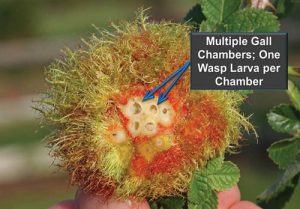
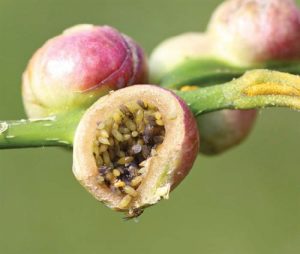
Mossy rose gall is a good example of a plurilocular, unilarval gall (multiple chambers but only one larva per chamber), while hickory phylloxera petiole gall is a typical unilocular, multilarval gall (one chamber hosting several larvae).
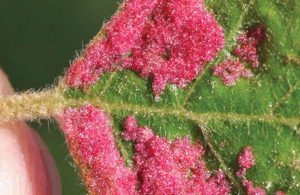
Certain eriophyid mites provide an example. These unusual mites are much smaller than spider mites (you need at least 40x magnification to see them); however, both types of mites use their sharp, piercing mouthparts (chelicerae) to rupture plant cells so they can feed on the contents. Only the feeding activity of some species of eriophyid mites induces gall growth; there are no spider mite gall-makers. This gall-growth pathway may explain how simple felt-like erineum patches (a.k.a. “erineum galls”) develop under the direction of a number eriophyid mite species. However, it does not explain how highly organized plant gall structures develop. <cColor:Word\_R255\_G0\_B0>
Some types of insect and mite galls are composed of complex plant structures and may include functional plant organs such as nectaries. These types of plant galls require a different gall-growth theory; one that includes the ability of the gall-maker to turn plant genes on and off as they direct plant cells to form highly organized plant structures.
Research has revealed that some gall-making insects and mites produce chemical replicas of plant hormones, or “plant hormone analogs” meaning the molecules are nothing like plant hormones but the plant’s response is the same as with plant hormones. The gall-forming process is usually initiated by the female when she injects gall-inducing chemicals into the plant along with her eggs. The eggs themselves may ooze gall-inducing chemicals and once the eggs hatch, the interaction continues with the immature gall-makers continuing to exude chemicals to direct plant growth to suit their needs.
The resulting galls provide both a protective home and nourishment for the next generation of gall-maker. The continual direction of gall growth by the gall-maker using chemicals to turn plant genes on and off speaks to why some find insect and mite plant galls so fascinating.
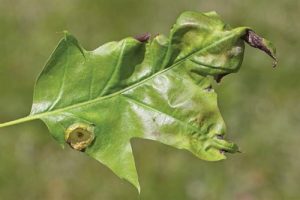
The oak anthracnose fungus, Apiognomonia quercina, is seen infecting the plant tissue of the small oak apple gall..
The chemicals exuded by gall-makers can only act upon meristematic plant cells, such as the cambial cells mentioned in Part 1 of this series or the meristematic cells in leaf buds; the precursors to leaf cells. Under the influence of chemicals exuded by a gall-maker, the meristematic cells that were originally destined to become leaf cells begin marching to a different drummer. Once the errant leaf cells fall under the chemical spell of a gall- maker, there is no turning back – they will become gall tissue. This means that gall formation cannot occur once meristematic leaf bud cells are committed to becoming leaf tissue; it’s one reason the leaf-gall season begins in the spring! However, once the galls start growing they will continue to grow, even after the leaves fully expand.
Stem galls that arise from cambial tissue present a different scenario. Since cambial cells remain “free agents” throughout the growing season, galls can be formed from these cells anytime during the growing season, although most stem galls also start growing early in the season to provide ample time for the gall-maker to complete its development.
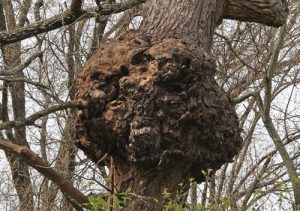
The large burl affecting this walnut is not a true gall.
Insect and mite gall identification
Identifying insect and mite galls is challenging because of the limited number of accurate and updated gall identification resources, both online and printed. This is particularly true for galls found in North America; the European gall literature is more robust.
The existing gall identification resources tend to follow the same general outline. Most begin by separating galls based on the gall-maker, such as wasp galls, midge galls, and so on. While it is ultimately important to know the gall-maker, gall identification usually starts with the gall itself.

We’ll provide a quick recap from Part I: The first step is to consider where the gall is found on the plant. Most identification resources use the following locations: leaf/petiole galls; flower/fruit galls; bud galls; stems galls; and root galls.
Next, galls are described based on their structure such as general appearance (for example, ball-like, hairy, etc.), number of chambers, and the number of gall-makers housed in the chambers. Recall that unilocular galls have only one chamber; plurilocular galls have multiple chambers. Unilarval galls only have one gall-maker per chamber; multilarval galls have more than one gall-maker per chamber. The aforementioned ball-like larger oak apple gall is a unilocular, unilarval gall. The hairy-looking mossy rose gall produced under the direction of the gall wasp, Diplolepis rosae; a species first described by Carl Linnaeus, is a plurilocular, unilarval gall with many chambers but only one larva per chamber.
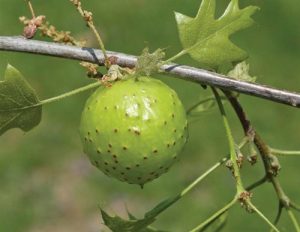
Looking like a green apple, a large oak apple gall contains a wasp larva; once the larva pupates, the mature gall turns tannish brown and appears empty.
The ball-like hickory petiole galls produced by several phylloxeran species (Phylloxera spp.) are usually unilocular, multilarval galls; there is a single chamber housing many of these aphid relatives.
Insect and mite gall laws
While the highly organized plant galls produced under the direction of many insect and mite gall-makers represent a wide range of forms and locations, there are certain consistencies that can be summarized as “gall laws.”

The First Gall Law: Galls are abnormal plant growths produced under the direction of a living gall-maker; they do not arise spontaneously, nor are they in response to plant wounding that does not involve a gall-maker. This law removes certain tree growth such as “burls” from the gall arena. It is believed these abnormal plant growths are the result of runaway plant hormone production; they are not considered “true galls.”
The Second Gall Law: Insect and mite galls are abnormal plant structures that are composed entirely of plant tissue; they’re not part of the gall-maker. Infections by fungal plant pathogens can illustrate that insect and mite plant galls are indeed plant structures. The oak anthracnose fungus, Apiognomonia quercina, normally infects the leaf cells of its namesake host producing blackened, necrotic leaf tissue. The fungus can also infect the plant tissue of the small oak apple gall produced under the direction of the gall wasp, Cynips clivorum, because the gall is constructed from hijacked leaf cells. The resulting tissue necrosis makes the gall appear to slowly dissolve away.
The Third Gall Law: Galls can only be formed from meristematic plant tissue and once plant tissue stops differentiating, galls cannot be formed by a gall-maker. This explains the seasonality of leaf and bud galls, as well as the ability for stem galls arising from cambial tissue anytime during the growing season.
The Fourth Gall Law: Gall structures and locations on the plant are so species-specific that the species of the gall-maker can be identified by the gall structure alone without the need to see the gall-maker itself. Although galls may change color and texture as gall-makers develop, and are said to be “mature” once the gall-maker completes its development, the changes are predictable.
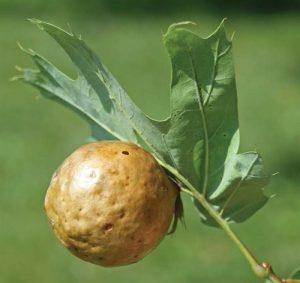
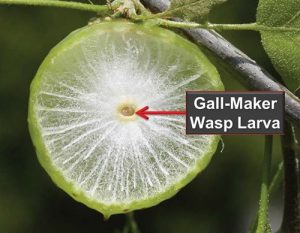
There are more than 20 different types of “oak apple” galls, so named because of their resemblance to varying sized apples. However, only one gall wasp species, Amphibolips quercusinanis (syn. A. inanis), produces the so-called larger empty oak-apple gall. The 1 to 1½-inch-diameter galls arise from leaf buds. The galls hold a single wasp larva and as the larva develops, the galls bear a striking resemblance to green apples with the apple-ruse made complete by reddish speckles that resemble insect damage to the “apples.” The galls are filled with soft fiber radiating spoke-like from a center kernel that houses the resident wasp larva. Once the larva pupates, the mature galls turn tannish brown and the fiber degrades, causing the galls to appear empty, thus the common name.
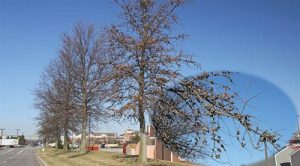
It is common to find the gnarled, woody, horned oak galls produced by the cynipid wasp, Callirhytis cornigera, affecting only a few trees in a whole row of seemingly related pin oaks (Quercus palustris).
The Fifth Gall Law: Gall-makers are specific to certain hosts. Their activity may be confined to a plant species, or certain varieties, cultivars or provenances within a species. It is common to find the gnarled, woody, horned oak galls produced by the cynipid wasp, Callirhytis cornigera, affecting only a few trees in a whole row of seemingly related pin oaks (Quercus palustris). This observation speaks to the impact of only slight genetic differences in the gall-makers’ host. Galling activity may also be confined to a group of related species within a genus. It is uncommon for gall-makers on white oaks to also reside on red oaks. What this means for gall management is that making slight changes in tree selection may eliminate a recurring gall problem in a landscape.
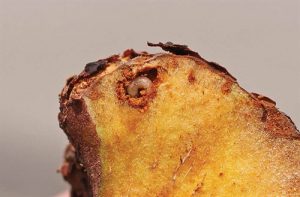
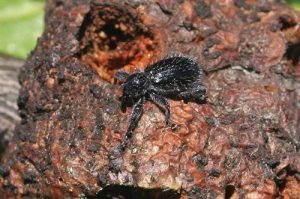
A weevil has colonized a cedar-apple rust gall.
Sixth Gall Law: Insect and mite galls may house other occupants that have nothing to do with gall formation; however, these interlopers still rely on the gall for both their lodging and food. Biologists call these gall-guests “inquilines,” a term derived from the Latin inquilinus, which means “tenant” or “lodger.” Inquilines are divided into cecidophages, arthropods that feed on the gall tissue while the gall-maker is developing, and successori, arthropods that feed on the galls after the gall-maker moves out.
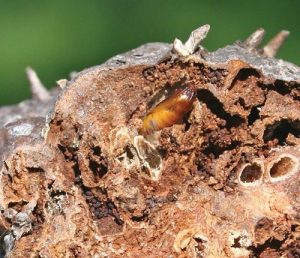
More than 20 different arthropods may wholly or partially depend upon the gnarled, woody, horned oak gall produced by the cynipid wasp, Callirhytis cornigera, for their livelihood.
Studies have shown that more than 20 different arthropods may wholly or partially depend upon the gnarled, woody, horned oak gall produced by the cynipid wasp, Callirhytis cornigera, for their livelihood. Arthropods may also colonize fungal galls, such as the aforementioned fungal black knot and cedar-apple rust galls, which may introduce some confusion as to the identity of the true gall-maker! Indeed, with the wide array of possible inquilines in some galls coupled with the predators and parasitoids that feed on the gall-maker as well as the inquilines, biologists often describe galls a mini-ecosystems; it’s a jungle in there!
Next up: Gall management.
The post INSECT AND MITE GALLS: MYTHS AND MISCONCEPTIONS appeared first on AmeriNursery.com.
]]>The post KEEPING TRACK OF ROSE ROSETTE DISEASE appeared first on AmeriNursery.com.
]]>
If you don’t gather them today, at least inspect them. They may be infected by rose rosette virus (RRV).
Rose rosette disease can be tricky. Its transmission involves three players: a virus, which is vectored by an eriophyid mite (Phyllocoptes fructiphilus), and the wild and sometimes invasive multiflora rose. For rose rosette disease to be successful, those three elements must be present. To break the cycle of this disease, eliminate one of the trio. Sounds easy. It’s not.
It’s believed that all cultivated roses are susceptible to the disease; this includes shrubs, hybrid teas, floribundas, grandifloras and miniatures. So even if there’s no evidence of multiflora in the immediate area, other roses may already carry the pathogen and can transmit it to your presumably clean stock. Once that happens, removal and destruction of the affected plants is your only option.
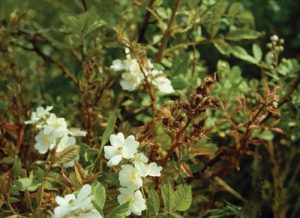
The brownish red panicle of an affected rose stands out against the normal flowers and healthy foliage of an adjacent plant.Photo courtesy James W. Amrine Jr., West Virginia University; Bugwood.org
What to look for
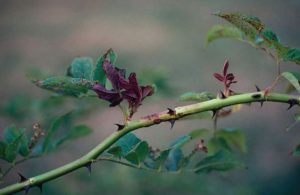
Symptoms of rose rosette disease can be difficult to recognize and confirm, as some signs mimic normal new growth. Many rose varieties are known for their richly colored young foliage, with leaves emerging a deep red to purple in spring. These generally turn green during the growing season, so if a plant continues to display intense red foliage throughout summer, it may have been infected.

Flushes of massed, tangled growth, similar to a witch’s broom, can signal the presence of rose rosette virus. This may be more evident in plants that have been infected for more than a year. Infected plants may display unusually large masses of distorted buds, most of which fail to open. Reddening and/or flattening of the cane can occur. Excessive thorn growth is an obvious sign.
Several of these symptoms appear similar to the signs of herbicide damage – which just adds to the challenge of confirmation.
Plants infected with RRV will decline and eventually die, but the disease may not be fatal for three to four years, by which time nearby plants may have been affected. Some speculate that rose rosette disease has become widespread in recent years due to the popularity of mass plantings, positioning plants close enough together to give the mite – which cannot fly, but can “balloon” on the wind – easy access to its next victim. So vigilance is key.
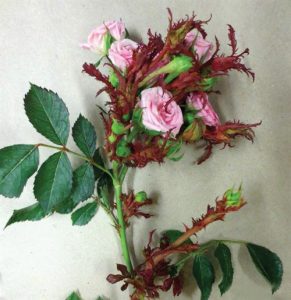
This plant shows the telltale dense flush of intensely colored young foliage, plus a mass of distorted flower buds.Photo courtesy of Sandra Jensen, Cornell University; Bugwood.org
How to manage rose rosette disease
Ultimately, the rose rosette virus is fatal. Once a plant is infected, it will not survive, so management of the disease is about preventing its spread to other plants.
Scouting for symptoms is vital to the long-term survival of nursery stock or landscape installations. It’s a good idea to inspect plants before they’re purchased, and take a look at neighboring plants, as well.
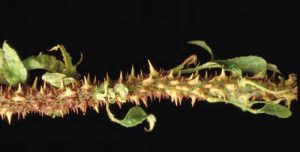
Roses have thorns, but this excessive growth is a sure sign of rose rosette disease.Photo courtesy of John Hartman, University of Kentucky; Bugwood.org
Although selective pruning of affected canes has been suggested as a possible means of management, this has proved – so far – to be ineffective. If signs of the disease are detected, the affected plants must be rogued. Many plants infected with RRV may remain asymptomatic; it’s a good idea to remove plants immediately surrounding them, providing a safeguard against further infection. Rogued plants should not simply be removed from the site, but bagged where they stand prior to removal.
Miticides have been suggested as possible “cure,” but to date, these methods have been unsuccessful.
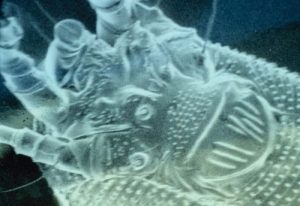
This is the ventral, or belly, view of a Phyllocoptes fructiphilus (eriophyid mite), as seen under an electron microscope. Spooky, no?Photo courtesy of Anatomy Department Archive, West Virginia University; Bugwood.org
The most effective way to fight rose rosette disease: Vigilance; early detection; roguing of affected plants.
There’s an excellent online resource at AmericanHort’s Knowledge Center, including a webinar and videos that help to explain the how’s, the what’s and the why’s. Go to http://www.americanhort.com, click on “Knowledge Center” and select Be In The Know.
Cover Photo courtesy of James W. Amrine Jr., West Virginia University; Bugwood.org. Rose petals: istock|EvelinElmest
The post KEEPING TRACK OF ROSE ROSETTE DISEASE appeared first on AmeriNursery.com.
]]>The post BOXWOOD BLIGHT UPDATE appeared first on AmeriNursery.com.
]]>Several Boxwood Blight infections have been detected in newly installed landscape plants across Alabama. Once infected Boxwoods are planted in a landscape, the pathogen can easily spread to established Boxwoods by splashing water (irrigation or rain) or infested equipment, soil, shoes, clothing or animals.
The Alabama Department of Agriculture & Industries (ADAI) is in the process of tracking down the source of these infected plants. Those that have derived from Retail Garden Centers, Nurseries, etc. in Alabama have a stop sale order placed on them, all boxwoods are inspected, and those found to be infected are destroyed. All infected plant material has, to date, been brought into Alabama from areas that are known to have problems with Boxwood Blight.
Some of these Boxwoods are also infected with Boxwood Blight and pin-pointing the source of these plants has been difficult. There are several Boxwood producers in Alabama that don’t have Boxwood Blight and are working hard to keep their material free of the disease.
The ADAI and Alabama Cooperative Extension System are working to survey areas where Boxwood Blight has been found in the landscape to prevent further spread of the pathogen. Landscape Maintenance Professionals should be observant of Boxwoods, become familiar with the symptoms of Boxwood Blight (leaf spots, black stem lesions, and defoliation), and report any suspected detections to local Extension Agent or Diagnostic Lab.
The post BOXWOOD BLIGHT UPDATE appeared first on AmeriNursery.com.
]]>