The post Guide to Humane Critter Control appeared first on AmeriNursery.com.
]]>Humane Critter Control
Photo: iStock unless otherwise noted.
Your clients spent a bundle on the best plants available, only to find out that they’re favored by local wildlife. But your clients also have very soft hearts when it comes to the cute critters who are making a meal out of their precious plants. How do you protect the plants while sparing the wildlife?
There are many humane options for preventing damage to valuable landscape plants, ranging from natural pheromones to physical barriers, but sometimes the most effective means of prevention is specific to the type of critter that’s causing the problem. The scariest scarecrow might prevent crows from depleting your clients’ small plot of artisanal corn, but it won’t mean a thing to that vole who’s wreaking havoc on the lawn.
Here’s a look at three of the most common — and vexing — animal pests, and what can be done to prevent devastating damage.
Rabbits love to chew the tender new foliage of perennials as well as, oh, whatever else is available.
Rabbits
Rabbits prefer to feed on the succulent foliage of grasses and herbaceous perennials, but they’re known to gnaw on the tender bark of young woody plants, too. Vegetables? They’re a given. (They also tend to breed like, well, rabbits, so if you see one culprit in the garden, you’ll likely see more.) What can be just as frustrating, however, is that they can cause extensive damage to irrigation lines by chewing through the plastic, especially if the system employs smaller diameter tubes.
How do you know if a rabbit is the outlaw causing devastation in the garden? Most damage will be found close to the ground, unless snow cover or natural ladders are available to help them reach higher. Even standing their hind legs, as they will occasionally do to reach munchies above their own height, the damage is usually limited to about one foot (or slightly higher) from the ground.
The more distinctive sign of rabbit feeding is the angle of the cut; sharp incisors allow them to make a characteristic 45-degree slice when they’re chewing off flower heads, buds or woody twigs. This damage is in contrast to that caused by browsing deer, who must twist and pull twigs and shoots on woody plants, leaving a ragged mess. (At least we can say that rabbits are neat.)
What to do?
Although many states consider rabbits to be game, your clients would just as soon not shoot anything but their budgets. So the three primary means of protection from rabbit damage are exclusion, trapping and repellents.
If the landscape permits, exclusionary netting or fencing can keep rabbits at bay. Chicken wire with a mesh size no larger than 1 inch (baby bunnies are small) can be mounted to light stakes or posts. The wirework should be a good 48 inches tall (rabbits can jump!), and the bottom should be buried at least 6 inches into the ground (rabbits can dig); 10 to 12 inches is better. This will prevent rabbits from burrowing under the fence to reach those tasty treats.
When we say, “if the landscape permits,” we’re thinking about aesthetics. Dark colored wire may blend with foliage, but remember that rabbits chew through plastic, so plastic netting won’t do.
Similar fencing may be required for use as trunk guards, protecting the tender bark of young saplings.
Live trapping may be a tricky solution. Why? Once trapped, the rabbit must be relocated. Many municipalities don’t allow transport and relocation of trapped wildlife, unless performed by a licensed agent. However, if trapping is allowed, the rabbit should be relocated a good five miles away, preferably in a wildland area, of course. And remember what we said about rabbits breeding like rabbits? Be prepared to set several traps and make several trips.
If the trapping solution is selected, it’s critical that the cages be inspected daily, if not several times a day. Are you willing to take on that task? Is your client?
Chemical repellents work by creating an odor or taste that is abhorrent to the pest. Repellents can be effective, but they should be applied before damage occurs and must be reapplied frequently. How often? It depends on the type of repellent (and what the label recommends), but in general reapplication should be made following rain or sprinkler irrigation, after a heavy dew, or when new growth emerges.
This prevention method is limited in effectiveness on many types of rabbit- friendly plants, however, because most of them should not be used on or near edibles. They’re most effective on trees, shrubs and vines.
Habitat management also can work; many rabbits prefer to snuggle cozily beneath cover of low-growing shrubs, within tall grasses or under nearby structures, coming out only to romp and feed. If such hideaways are eliminated, the critters likely will hop along to a safer garden. But some gardens happily feature low-growing plants and ornamental grasses, which clients would prefer to keep. Tidying up helps.
Although not necessarily the worst offenders, squirrels may steal fruit and nuts or nibble on some plants.
Squirrels
If your projects include areas for edible plants, make sure the homeowners understand that squirrels, those adorable, acrobatic little rascals, will nibble just about anything humans want to harvest. So it’s often recommended that diversionary tactics be employed. Distract them; offer them their own feeder, complete with nuts or cracked corn, the thinking goes, and they’ll be so happy they won’t bother the garden plants.
However, these industrious little beasts also cause indirect damage to plants by digging and burying their treasures. This can create a mess in the neatly laid mulch; worse, their digging can disrupt roots. Plus, if the seed they cache is capable of sprouting, the homeowner may be surprised to find lush stalks of corn sprouting among the Coreopsis. (Corn often can be found sprouting in gutters, too, but that’s a problem for the homeowner’s handyman.)
On the other hand, when they’re not digging to bury future meals, they’re digging to find tasty bulbs; squirrels love tulip and crocus bulbs and can sniff them out wherever they’re planted. Daffodils? Not so much.
Fruits and nuts growing on trees offer a veritable banquet for squirrels, and it doesn’t matter whether the apples, for example, are produced on ornamental crabs or orchard trees. They’ll also chew the tender buds of trees, which, if the pests are ravenous enough, can result in slight defoliation.
Lawns also suffer from squirrel damage, although it’s merely aesthetic. These rodents will bury their winter food supply wherever they can, and often that’s in the middle of the lawn. Small holes, usually about the size of a U.S. quarter, may dot the yard come fall, when the drop in temperature triggers their caching instinct. Turf will recover nicely without intervention.
Robust corn stalks growing among sedum are a sure sign of squirrel activity.
Photo: Sally Benson
What to do?
As with rabbits, exclusion may be the best option for protecting precious plants from squirrel damage. If your garden design includes small flowering trees and shrubs that produce fruit, netting the entire plant for a period may help to preserve the crop. Because squirrels are capable of climbing just about anything, a small cage barrier at the base of the trunk will only give them more equipment for their gymnastics.
Fruit trees also can be protected by wrapping the trunk with a band of sheet metal, located about 6 feet above the ground. The band should be about 1-1/2 to 2 feet wide. This slippery surface will present the little climbers with too great a challenge to reach the buds and fruit in the tree’s crown. Bands should not be left on permanently, and they may work only if surrounding trees are also banded, or if trees are not sited close enough for squirrels to jump from the branches of one tree to the next.
Just as with rabbits, if your client prefers trapping to manage the squirrel pests, be sure to check the local and state laws regarding their handling. Trapping squirrels has become a profit center for many private wildlife management companies; the little devils love to make their way into attics to nest. Hiring such a company is an option, and it transfers responsibility to another party, allowing you to do what you’d rather be doing.
The application of repellents can be an effective way to deter squirrels, and those containing capsaicin are especially popular. Oil of mustard, peppermint oil and vinegar also can be employed, with varying results. Remember that repellents require vigilance and repeated application.
On the other hand, commercial ultrasonic devices can effectively annoy the heck out of small critters, sending them packing to the neighbor’s crop. The frequency emitted is inaudible to humans, so it won’t bother the homeowners (or their neighbors), and it’s also inaudible to dogs and cats. These devices may take a while to be effective, up to 2 weeks in some cases, but aside from requiring an electrical cord running through the garden, it’s harmless to all but the pests.
Motion-activated sprinklers, often recommended for squirrel management, can scare away unwanted critters by briefly squirting a sharp stream of water toward whatever living being enters its perceived territory. Thus, it also squirts welcome critters, including the family dog. Or party guests.
As for the old trick of hanging scratched CDs in trees? Who has CDs?
Much of the damage caused by voles can be seen in the extensive network of tunnels they create throughout lawn areas.
Voles (and similar rodents)
Tiny voles come in a variety of species and appetites, but the common vole is a primary pest of that lovely carpeted lawn. They’re active 24/7, and because much of their activity is underground, you may not know they’re around until you see the damage. Their tunneling behavior is legendary; these miniature creatures create a vast network of tunnels and burrows where they nest, breed and store the fruits of their foraging efforts. Intertwining highways of vole damage can be seen in otherwise healthy lawns.
Their urban planning efforts aside, voles (and other tiny beasts) can cause extensive damage to a variety of ornamental plants, feeding on grasses, perennials, bulbs and tubers, and seeds. They love their vegetables. They dig in containers. They gnaw on shoots and leaves.
The bark of small trees and shrubs also feeds voles, who are poor climbers but can cause lethal damage by chewing enough bark to girdle trunks. Even in winter they’ll snuggle under snow cover, if they’re lucky to find such, and nibble on whatever’s available, — most likely the bark of small trees and shrubs. Damage may be evident from a few inches aboveground to a few inches below ground, and even though their tiny legs are not built for scaling trunks, they can climb onto low branches and eat their way ever higher.
He’s adorable, yes, but he ate my tree.
What to do?
Habitat modification and exclusion may be the most effective ways of preventing extensive vole damage. They love to take up residence underground, of course, but they’re also partial to settling in among weeds, heavy mulch layers and dense vegetation. Cleaning up the area helps. For trees in particular, provide a 4-foot-diameter around the base that is free of vegetation; voles don’t like exposure, and if there’s no place to hide, they’ll go elsewhere.
Wire fencing with a mesh size of ¼ inch or smaller — yes, that’s tiny, but so are the voles — will help to exclude them from protected areas. Fencing should reach about 12 inches aboveground and should be buried 6 to 10 inches belowground. (Remember, these guys are expert tunnelers.)
Photo: Sally Benson
Tender trunks can be protected with tubes of heavy plastic, sheet metal or hardware cloth, but be sure that there’s sufficient room for the trunk to grow. The cylinders should be buried slightly, and in areas where snow cover is likely, they should be tall enough to extend above the snow level. Such sleeves should be monitored closely to be sure voles haven’t been able to sneak past the barrier and high inside the guard.
Live trapping and relocation isn’t often recommended, primarily because of the large population and the number of traps required to make a difference. (Voles are prolific, with females capable of having five to 10 litters of 3 to 6 pups per year.) That, and their network of tunnels makes it quite the challenge to capture.
The use of repellents is, unfortunately, not often successful. Although commercial repellents are available, their use is often simply not practical.
So we turn to natural control. With the exurbs and the suburbs increasingly encroaching on wild lands, predators are no longer uncommon. Foxes and coyotes, both of which feed on small rodents, may help to control the population. Owls and hawks also eat voles. None of these will eliminate the problem completely, but they may remove enough to create a more acceptable balance.
Small mammalian plant pests can be managed humanely, although it takes ingenuity and patience. Lacking that, employ the homeowner’s dog or cat.
Read more: Managing Rabbits, Rodents and Slugs
The post Guide to Humane Critter Control appeared first on AmeriNursery.com.
]]>The post INSECT AND MITE GALLS: MYTHS AND MISCONCEPTIONS appeared first on AmeriNursery.com.
]]>
In the first installment of this series on plant galls (May 2015), we talked about the difference between gall-like structures and true galls, including bacterial crown galls, fungal galls, leaf/petiole galls, flower/fruit galls, bud galls and stem galls. Galls galore! But there’s more.
Let’s dig deeper into insect and mite (arthropods) galls. Unlike bacterial crown galls, which are a mass of plant cells that have been modified by bacterial DNA, or fungal galls, which are an assemblage of fungal cells intertwined with plant cells, galls produced by insects and mites are constructed entirely of plant cells.
Dominant arthropod gall-makers include insects belonging to three orders: Hymenoptera (wasps, sawflies); Hemiptera (aphids/adelgids, phylloxerans, psyllids); and Diptera (midge flies). The only mites capable of inducing galls are eriophyids (order Trombidiformes, family Eriophyidae).
There are more than 2,000 species of insect gall-makers in the U.S.; however, three quarters belong to only two families: Cynipidae (“gall wasps”) and Cecidomyiidae (“gall midges”). Note the “cecido-” in the name of the gall midge family; Cecidology is the scientific study of plant galls. Of the over 800 different gall-makers on oaks, more than 700 are gall wasps. In other words, when trying to identify an insect gall, keep in mind that there is a high probability it was produced by a gall wasp or gall midge.
Although insect and mite gall formation is not entirely understood, researchers theorize there are two possible pathways. Some gall researchers believe certain types of plant gall growth are directed by the feeding activity of the gall-maker. The galls are produced by a combination of constant but subtle feeding irritation, perhaps coupled with the release of chemical inducers by the gall-maker.
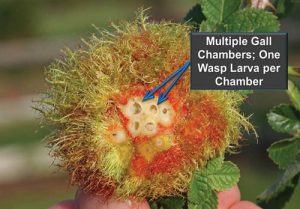
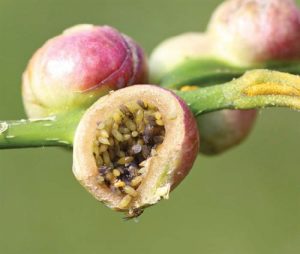
Mossy rose gall is a good example of a plurilocular, unilarval gall (multiple chambers but only one larva per chamber), while hickory phylloxera petiole gall is a typical unilocular, multilarval gall (one chamber hosting several larvae).
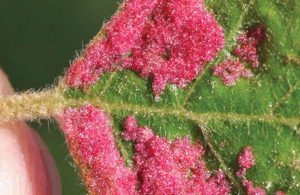
Certain eriophyid mites provide an example. These unusual mites are much smaller than spider mites (you need at least 40x magnification to see them); however, both types of mites use their sharp, piercing mouthparts (chelicerae) to rupture plant cells so they can feed on the contents. Only the feeding activity of some species of eriophyid mites induces gall growth; there are no spider mite gall-makers. This gall-growth pathway may explain how simple felt-like erineum patches (a.k.a. “erineum galls”) develop under the direction of a number eriophyid mite species. However, it does not explain how highly organized plant gall structures develop. <cColor:Word\_R255\_G0\_B0>
Some types of insect and mite galls are composed of complex plant structures and may include functional plant organs such as nectaries. These types of plant galls require a different gall-growth theory; one that includes the ability of the gall-maker to turn plant genes on and off as they direct plant cells to form highly organized plant structures.
Research has revealed that some gall-making insects and mites produce chemical replicas of plant hormones, or “plant hormone analogs” meaning the molecules are nothing like plant hormones but the plant’s response is the same as with plant hormones. The gall-forming process is usually initiated by the female when she injects gall-inducing chemicals into the plant along with her eggs. The eggs themselves may ooze gall-inducing chemicals and once the eggs hatch, the interaction continues with the immature gall-makers continuing to exude chemicals to direct plant growth to suit their needs.
The resulting galls provide both a protective home and nourishment for the next generation of gall-maker. The continual direction of gall growth by the gall-maker using chemicals to turn plant genes on and off speaks to why some find insect and mite plant galls so fascinating.
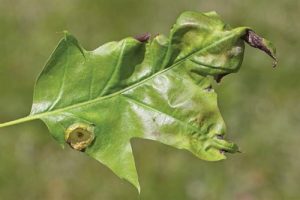
The oak anthracnose fungus, Apiognomonia quercina, is seen infecting the plant tissue of the small oak apple gall..
The chemicals exuded by gall-makers can only act upon meristematic plant cells, such as the cambial cells mentioned in Part 1 of this series or the meristematic cells in leaf buds; the precursors to leaf cells. Under the influence of chemicals exuded by a gall-maker, the meristematic cells that were originally destined to become leaf cells begin marching to a different drummer. Once the errant leaf cells fall under the chemical spell of a gall- maker, there is no turning back – they will become gall tissue. This means that gall formation cannot occur once meristematic leaf bud cells are committed to becoming leaf tissue; it’s one reason the leaf-gall season begins in the spring! However, once the galls start growing they will continue to grow, even after the leaves fully expand.
Stem galls that arise from cambial tissue present a different scenario. Since cambial cells remain “free agents” throughout the growing season, galls can be formed from these cells anytime during the growing season, although most stem galls also start growing early in the season to provide ample time for the gall-maker to complete its development.
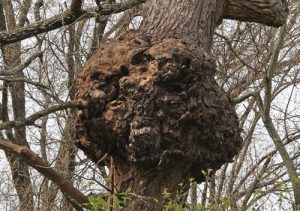
The large burl affecting this walnut is not a true gall.
Insect and mite gall identification
Identifying insect and mite galls is challenging because of the limited number of accurate and updated gall identification resources, both online and printed. This is particularly true for galls found in North America; the European gall literature is more robust.
The existing gall identification resources tend to follow the same general outline. Most begin by separating galls based on the gall-maker, such as wasp galls, midge galls, and so on. While it is ultimately important to know the gall-maker, gall identification usually starts with the gall itself.

We’ll provide a quick recap from Part I: The first step is to consider where the gall is found on the plant. Most identification resources use the following locations: leaf/petiole galls; flower/fruit galls; bud galls; stems galls; and root galls.
Next, galls are described based on their structure such as general appearance (for example, ball-like, hairy, etc.), number of chambers, and the number of gall-makers housed in the chambers. Recall that unilocular galls have only one chamber; plurilocular galls have multiple chambers. Unilarval galls only have one gall-maker per chamber; multilarval galls have more than one gall-maker per chamber. The aforementioned ball-like larger oak apple gall is a unilocular, unilarval gall. The hairy-looking mossy rose gall produced under the direction of the gall wasp, Diplolepis rosae; a species first described by Carl Linnaeus, is a plurilocular, unilarval gall with many chambers but only one larva per chamber.
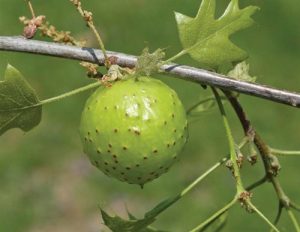
Looking like a green apple, a large oak apple gall contains a wasp larva; once the larva pupates, the mature gall turns tannish brown and appears empty.
The ball-like hickory petiole galls produced by several phylloxeran species (Phylloxera spp.) are usually unilocular, multilarval galls; there is a single chamber housing many of these aphid relatives.
Insect and mite gall laws
While the highly organized plant galls produced under the direction of many insect and mite gall-makers represent a wide range of forms and locations, there are certain consistencies that can be summarized as “gall laws.”

The First Gall Law: Galls are abnormal plant growths produced under the direction of a living gall-maker; they do not arise spontaneously, nor are they in response to plant wounding that does not involve a gall-maker. This law removes certain tree growth such as “burls” from the gall arena. It is believed these abnormal plant growths are the result of runaway plant hormone production; they are not considered “true galls.”
The Second Gall Law: Insect and mite galls are abnormal plant structures that are composed entirely of plant tissue; they’re not part of the gall-maker. Infections by fungal plant pathogens can illustrate that insect and mite plant galls are indeed plant structures. The oak anthracnose fungus, Apiognomonia quercina, normally infects the leaf cells of its namesake host producing blackened, necrotic leaf tissue. The fungus can also infect the plant tissue of the small oak apple gall produced under the direction of the gall wasp, Cynips clivorum, because the gall is constructed from hijacked leaf cells. The resulting tissue necrosis makes the gall appear to slowly dissolve away.
The Third Gall Law: Galls can only be formed from meristematic plant tissue and once plant tissue stops differentiating, galls cannot be formed by a gall-maker. This explains the seasonality of leaf and bud galls, as well as the ability for stem galls arising from cambial tissue anytime during the growing season.
The Fourth Gall Law: Gall structures and locations on the plant are so species-specific that the species of the gall-maker can be identified by the gall structure alone without the need to see the gall-maker itself. Although galls may change color and texture as gall-makers develop, and are said to be “mature” once the gall-maker completes its development, the changes are predictable.
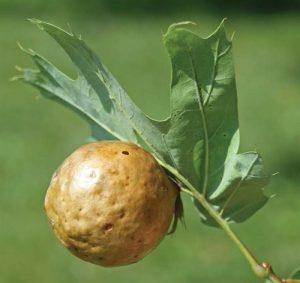
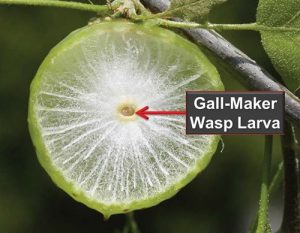
There are more than 20 different types of “oak apple” galls, so named because of their resemblance to varying sized apples. However, only one gall wasp species, Amphibolips quercusinanis (syn. A. inanis), produces the so-called larger empty oak-apple gall. The 1 to 1½-inch-diameter galls arise from leaf buds. The galls hold a single wasp larva and as the larva develops, the galls bear a striking resemblance to green apples with the apple-ruse made complete by reddish speckles that resemble insect damage to the “apples.” The galls are filled with soft fiber radiating spoke-like from a center kernel that houses the resident wasp larva. Once the larva pupates, the mature galls turn tannish brown and the fiber degrades, causing the galls to appear empty, thus the common name.
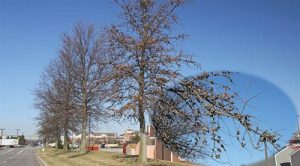
It is common to find the gnarled, woody, horned oak galls produced by the cynipid wasp, Callirhytis cornigera, affecting only a few trees in a whole row of seemingly related pin oaks (Quercus palustris).
The Fifth Gall Law: Gall-makers are specific to certain hosts. Their activity may be confined to a plant species, or certain varieties, cultivars or provenances within a species. It is common to find the gnarled, woody, horned oak galls produced by the cynipid wasp, Callirhytis cornigera, affecting only a few trees in a whole row of seemingly related pin oaks (Quercus palustris). This observation speaks to the impact of only slight genetic differences in the gall-makers’ host. Galling activity may also be confined to a group of related species within a genus. It is uncommon for gall-makers on white oaks to also reside on red oaks. What this means for gall management is that making slight changes in tree selection may eliminate a recurring gall problem in a landscape.
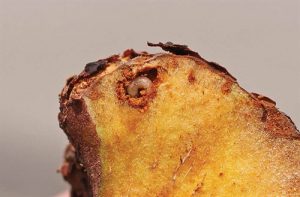
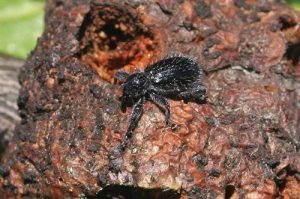
A weevil has colonized a cedar-apple rust gall.
Sixth Gall Law: Insect and mite galls may house other occupants that have nothing to do with gall formation; however, these interlopers still rely on the gall for both their lodging and food. Biologists call these gall-guests “inquilines,” a term derived from the Latin inquilinus, which means “tenant” or “lodger.” Inquilines are divided into cecidophages, arthropods that feed on the gall tissue while the gall-maker is developing, and successori, arthropods that feed on the galls after the gall-maker moves out.
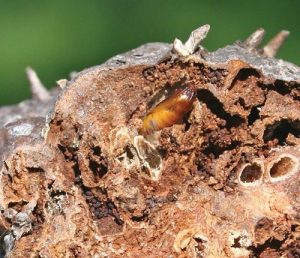
More than 20 different arthropods may wholly or partially depend upon the gnarled, woody, horned oak gall produced by the cynipid wasp, Callirhytis cornigera, for their livelihood.
Studies have shown that more than 20 different arthropods may wholly or partially depend upon the gnarled, woody, horned oak gall produced by the cynipid wasp, Callirhytis cornigera, for their livelihood. Arthropods may also colonize fungal galls, such as the aforementioned fungal black knot and cedar-apple rust galls, which may introduce some confusion as to the identity of the true gall-maker! Indeed, with the wide array of possible inquilines in some galls coupled with the predators and parasitoids that feed on the gall-maker as well as the inquilines, biologists often describe galls a mini-ecosystems; it’s a jungle in there!
Next up: Gall management.
The post INSECT AND MITE GALLS: MYTHS AND MISCONCEPTIONS appeared first on AmeriNursery.com.
]]>