The post SHORT AND SWEET appeared first on AmeriNursery.com.
]]>Select from the plants featured here, or check out those listed in the sidebar. They may be little, but we don’t have room to feature all of these exceptional plants!
Arrhenatherum elatius subsp. bulbosum ‘Variegatum’
Arrhenatherum elatius subsp. bulbosum ‘Variegatum’
Photo courtesy of Hoffman Nursery Inc.
Clump-forming striped tuber oat grass is a slow-spreading groundcover selection that reaches about 8 inches tall; up to 12 or 14 inches when in flower. Narrow green leaves feature dramatic white margins, and the plant can sometimes appear to be all white. Although the foliage and habit give the plant a spiky look, the leaves are actually soft.
Striped tuber oat grass is happiest in part to full shade, where it shines in contrast to darker leaved companions. It should be kept evenly moist, but can be drought tolerant once established. A cool season variety, it will go dormant in midsummer, but can be cut back during the warmest days to allow for fresh growth once cool temperatures return in the fall.
Hardy in zones 4 to 8.
Bouteloua gracilis
Bouteloua gracilis
Photo courtesy of Hoffman Nursery Inc.
Blue grama (sometimes called mosquito grass) is an outstanding choice for the low-moisture garden; because of its unique, horizontal seed heads, however, it’s a real standout in any setting. Waving like banners above gray- to blue-green, exceptionally narrow foliage, the elongated, purplish flowers turn tan to brown in fall, remaining ornamental well into the cold months. The cultivar ‘Blonde Ambition’, introduced by David Salman of High Country Gardens, features flowers that emerge a light chartreuse and turn pale blonde.
Blue grama performs beautifully in nearly any setting, but is especially suited to sunny rock gardens, the front of a border, as a groundcover—and even as a low-maintenance substitute for lawns.
Hardy in zones 3(4) to 9.
Deschampsia cespitosa
Deschampsia cespitosa
Photos courtesy of Hoffman Nursery Inc.
Tufted hair grass (what a great name!) develops a tufted mound of slender, clean, medium-green foliage that reaches to about 12 inches; when in flower, it’s only about 18 inches tall, but can reach even taller in optimal conditions. The wispy, light green inflorescences are nearly transparent, providing a delicate, lacy haze through which background plants can be viewed. In fall, the flowers turn tan to light bronze and form a dramatic cloud through the winter months.
Tufted hair grass is a cool season selection that performs well in full sun to light shade; its foliage serves as a good companion to plants with variegated leaves, as well as flowering natives such as Rudbeckia and Echinacea.
Hardy in zones 4 to 7, but is said to have reliably greater cold tolerance.
Festuca species
Festuca
Photo: iStock | Marakit_Atinat
Festuca glauca ‘Elijah Blue’ has become one of the bread-and-butter, go-to plants of the American landscape, but there are other lovely fescues that deserve attention. If your clients insist on blue, try F. glauca ‘Select’, which shares the glowing silver-gray-blue hues of its close relative, or for a larger plant, F. glauca ‘Boulder Blue’ can easily win their hearts. ‘Boulder Blue’ grows to about 10 inches tall, with flower spikes reaching 12 inches in late spring or early summer. F. idahoensis ‘Siskiyou Blue’ bears the strong, gray-blue that’s a favorite among gardeners, but the foliage appears to be a bit less dense than other selections. Growing to about 10 to 14 inches tall, it has a rather formal appearance.
Festuca amethystine (tufted or hair fescue) boasts a greener shade of foliage, but mirrors the typical, ebullient growth habit of a rounded mound that appears to burst from the soil. True to its name, a cultivar called ‘Superba’ begins with bright blue foliage, then shows rich amethyst-colored foliage and flowers come bloom time.
For a tiny addition to the rock garden or the front border, F. gautieri (bearskin fescue) is the perfect choice. Medium to dark green, prickly, pincushion-like foliage grows only to about 2 to 6 inches tall in a tight, dense mound.
Most selections prefer full sun; many are reliably drought tolerant.
Hardy in zones 4 to 7(8).
Koeleria vallesiana
Koeleria vallesiana ‘Mountain Breeze’
Photo courtesy of Bluestem Nursery
Somerset hair grass holds its narrow, steel-blue to dark green foliage proudly erect, reaching to 10 to 12 inches in full sun to light shade. The plants form slender clumps that serve as excellent companions to sedums, alliums and other grasses. Planted in rock gardens or borders—even in containers with good drainage—this selection is a show stopper.
But it’s the flowers that really dazzle. Profuse blooms emerge from long and narrow but sturdy stalks, and the bright, greenish-yellow flowers are a highlight in the landscape. Blooms emerge in late spring to summer and form masses of bobbing and swaying plumes.
Seen in the foreground of this photo is another exceptional grass—Luzula nivea (lesser woodrush or snowy woodrush) — whose pure white flowers often are used in dried arrangements.
Hardy in zones 3 to 8.
Sesleria autumnalis
Sesleria autumnalis
Photo: iStock | AlpamayoPhoto
Autumn moor grass, as its common name implies, shows off its best assets in late summer and fall with a dramatic display of silvery white inflorescenses that dance a full foot above the 12-inch base foliage. This cool season grass produces a nicely formed mound of yellow-green leaves in spring and enjoys full sun to part shade locations. It requires ample moisture to establish, but is reliably drought tolerance after that.
Throughout the growing season, autumn moor grass provides a beautiful accent in the border or in mixed plantings; it’s also a good choice for roof gardens and urban settings. It plays well with other, taller grasses, and is especially attractive when accented by autumn-blooming crocus. Once the slender flower spikes emerge, however, this grass has the stage all to itself.
Hardy in zones 4 to 7.
Sporobolus heterolepis
Sporobolus heterolepis
Photos courtesy of Hoffman Nursery Inc.
A slightly larger small grass, prairie dropseed reaches about 12 to 24 inches in softly clumping forms; when in flower, spikes can reach up to 36+ inches tall. Spring foliage is deep green with narrow leaves that arch gracefully downward. Flower stalks rise in midsummer to carry open, airy panicles that turn light tan in fall. Autumn foliage is a dramatic, fiery copper—a real standout in the garden.
Used as a groundcover, prairie dropseed is lush and inviting, but it’s also nicely suited to borders, slopes and use as a lawn substitute. This tough native plant is drought tolerant and low maintenance.
Hardy in zones (3)4 to 9.
The post SHORT AND SWEET appeared first on AmeriNursery.com.
]]>The post HYDRANGEA ARBORESCENS ‘DARDORN’ appeared first on AmeriNursery.com.
]]>
They started out as liners, scrawny little sticks with scant visible potential, but there was room at the fence for filler, so into the soil they went. I’m a fool for hydrangeas and will take practically any opportunity to try another, despite the lack of decent soil and sun exposure in my postage-stamp back yard. The routine? Dig, plant, hope for the best.
Lo and behold! A few months’ worth of neglect later, I got the best.
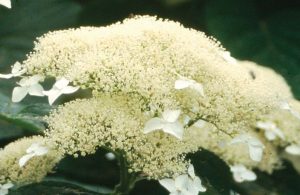
White Dome hydrangea (Hydrangea arborescens ‘Dardorn’; smooth hydrangea) has been a consistent and reliable performer for more than 15 years, growing robustly each spring from a drastically pruned crown (about 6 to 12 inches tall) to a lush, fully rounded shrub that reaches nearly 5 feet tall and wide. Though its branches are relatively slender, they stand strong and proud, sporting dark green foliage that shows pale green undersides in the slightest breeze and remains clean throughout the season. The elliptic leaves, some reaching 6 to 8 inches long, are toothed, although not dramatically so. Fall color, at least in my experience, is inconsequential.
Dome-shaped, lacecap-type inflorescences emerge a light green in spring, developing to white or off white; fertile flowers are occasioned by a few sterile flowers—rarely are there enough to qualify as a true lacecap. The large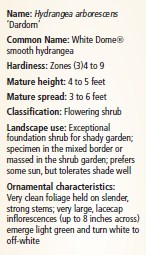 infloresences often expand to nearly 10 inches in a good year; more commonly, they reach 6 to 8 inches across. Still, even the largest blooms have yet to bend the plant’s stems.
White Dome blooms on new wood, so an enthusiastic pruning is called for. I’ve cut mine back both in late winter and well into spring with similar results: vigorous growth and long-lasting performance.
The site I chose for my plants receives an hour or two of morning sun, followed by dappled shade, and they’re very happy. I did little to improve the poor, clay soil, but the plants seem to thrive and grow more robust each year. Smooth hydrangea is tolerant of a range of soils, including clay, dry, wet, rocky, shallow … and these plants prove that point. They require precious little maintenance, although they’re excellent canaries in the coal mine when it comes to droughty conditions. They’re among the first to droop slightly— that’s my signal to haul out the hose and give them a decent drink, and they’re satisfied. This happens rarely, however, and there have been several seasons during which they thrived on rainwater alone. On the other hand, they do well when it’s ridiculously wet, and don’t mind standing water.
My site is located in Zone 5, where White Dome is very happy; it’s hardy in zones 3 or 4 to 9.
The species suffers very little from serious insect or disease problems; occasional bouts of bacterial wilt, leaf spots, rust and powdery mildew may occur. For one reason or another, I’ve been lucky and have observed only an occasional perforated leaf. This is rare, and I’ve seldom seen insects (other than a few bees); even the rabbits that inhabit my garden don’t bother.
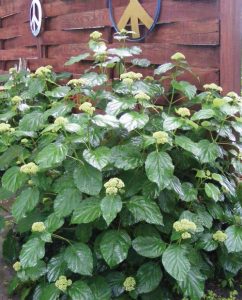
Photo courtesy of Sally Benson
White Dome is not a spectacular plant; there’s little pizzazz and the color is simply pleasing. That’s not to say it’s not beautiful. There’s tremendous value in a plant that loves to perform, day in and day out, season after season. In my garden, that’s saying a lot.
Photo courtesy of Proven Winners
The post HYDRANGEA ARBORESCENS ‘DARDORN’ appeared first on AmeriNursery.com.
]]>The post UP ON THE ROOF appeared first on AmeriNursery.com.
]]>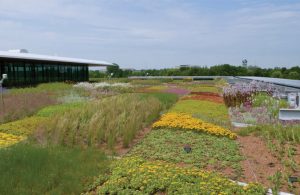
The significance of green roofs in urban areas has steadily increased over the past 20 years. In the United States, as well as worldwide, green roofs have become vital components of new construction on a broad variety of buildings, from municipal to commercial and industrial to residential. The benefits of green roofs are measured in environmental, economic and aesthetic or cultural ways. In its simplest form, a green roof may contain a sampling of sedums or other hardy succulents; whereas, many modern green roofs have increased the range and diversity of plants being grown by installing deeper growing medium and changing the way green roofs are utilized or experienced. Whether strictly utilitarian or highly specialized and ornamental, green roofs have a variety of benefits over a traditional roof.
When choosing plants for green roofs it is important to understand that a green roof is not the equivalent of a typical landscape elevated to the top of a building; therefore, appropriate consideration must be given to a plant’s growth habit, native ecosystem and cultural needs, to name a few factors. Many common garden plants will not survive on a green roof. In Green Roof Plants, Ed Snodgrass succinctly describes the ideal traits for a good green roof plant: “The most successful green roof plants are low-growing, shallow-rooted perennial plants that are heat, cold, sun, wind, drought, salt, insect and disease tolerant. Green roof plants should also have a long life expectancy or the ability to self-propagate, and they should require minimal nutrients and maintenance.” Needless to say, selecting the right plants for green roofs is anything but simple.
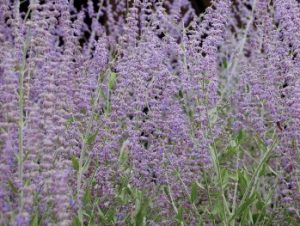
Photo Courtesy of iStock | JoolsBerlin.
The Chicago Botanic Garden Green Roof Gardens
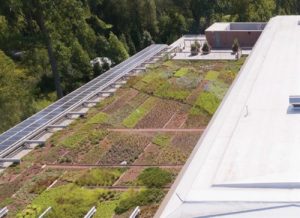
In September 2009, the Chicago Botanic Garden opened its Daniel F. and Ada L. Rice Plant Conservation Science Center, a 38,000-square-foot LEED Gold-rated research and laboratory facility. Atop the Center is a 16,000-square-foot green roof, divided into two 8,000 square foot gardens, which display a variety of North American native plants and exotic plants from around the world. The green roof is both a living laboratory and a beautifully designed garden, with the two-fold purpose of displaying the best plants for green roofs and trialing untested plants for their adaptability to this challenging environment. The ultimate goal of the trial is to develop a diverse and extensive list of recommended plants for green roof culture. Greater plant diversity supports the aesthetic design of a green roof as well as creating a habitat for a variety of beneficial pollinators and other wildlife.
Photo courtesy of iStock | AlpamayoPhoto
Performance report
Between 2010 and 2014, 216 herbaceous and woodytaxa were evaluated in the green roof gardens; 129 taxa on the north roof and 87 taxa on the south roof. Data collection for the 156 taxa planted in August 2009 commenced in April 2010; 60 additional taxa started their trial in June 2011. A combined total of 41,561 individual plants were planted on the green roof in 2009 and 2011.
All plants were evaluated for their 1) cultural adaptability to the growing medium and environmental conditions on the green roof; 2) disease and pest problems; 3) winter hardiness or survivability; and 4) ornamental qualities associated with flowers, foliage and plant habit. In addition, plants were monitored for reseeding and weediness. Final performance ratings are based on plant health and vigor, survivability and longevity, habit quality and flower production, and winter hardiness during the evaluation period.
Nine taxa received five-star excellent ratings for their overall performance and survivability, including Antennaria dioica, Calamintha nepeta ssp. nepeta, Juniperus chinensis var. sargentii ‘Viridis’, Phlox subulata ‘Apple Blossom’, Phlox subulata ‘Emerald Snow’, Phlox subulata ‘Snowflake’, Rhus aromatica ‘Gro-Low’, Sporobolus heterolepis and Sporobolus heterolepis ‘Tara’. Top-rated plants consistently displayed good vigor and robust habits, superior ornamental qualities, disease resistance, heat and drought tolerance, and winter hardiness/survivability throughout the evaluation period. Additionally, 69 taxa received four-star good ratings for their strong performances.up-on-the-roof2
Early success for a portion of the taxa was evident by the end of the first full growing season in 2010.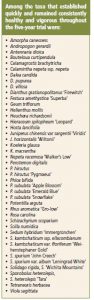
Some taxa were consistently healthy but either slower to establish, slow to increase in size, and/or more affected by environmental conditions; however, by the end of the trial all of these taxa were good performers. Amorpha nana took five years to become a substantial size, although it remained irregular in habit. Asclepias tuberosa was very slow-growing; Baptisia alba var. alba was few-stemmed and open until the fifth season; Campanula rotundifolia was slow to bulk up until the third year; Coreopsis verticillata ‘Zagreb’ always had a loose habit. Eryngium yuccifolium was very slow to gain size; Fragaria virginiana was slow to begin spreading and its stolons were continually damaged during hot, droughty periods. Galium verum was not vigorous until the third season, except for its seedlings; Heuchera micrantha ‘Palace Purple’ grew well but off-colored dramatically in hot weather. Iris tectorum grew best in the shadier section of the bed; Lespedeza capitata was spindly for a couple of years. Liatris ligulistylis was slow to bulk up, often only single-stemmed; Oligoneuron album was fairly static until the third year when it began to reseed widely and the seedlings were more vigorous than the original plants.
Perovskia atriplicifolia was a bit loose in habit; Petrorhagia saxifraga ‘Rosea’ was healthiest interplanted with Phlox subulata ‘Emerald Blue’, whereas it lacked vigor on its own. Potentilla fruticosa was rarely bushy, being loose and uneven in habit; Pycnanthemum virginianum remained loose and often single-stemmed. Salvia ×sylvestris ‘East Friesland’ had a tight habit but never gained any size; Symhyotrichum ericoides ‘Snow Flurry’ stayed prostrate and never developed arching stems like it does in a garden. Symphyotrichum sericeum had an open to spindly habit; Talinum calycinum was slow to establish until it began to reseed; Thymus praecox ‘Coccineus’ did not become vigorous until the third year; and Tradescantia tharpii was slow to increase in size. Oenothera fruticosa ‘Fireworks’ and Oenothera macrocarpa were strong performers for three years but unexpectedly began to decline and die out in 2013.
Monitoring heat and drought
Environmental conditions, especially excessive heat and drought, were closely monitored to determine how they affected the health, vigor and survivability of the plants. Together or alone, heat and drought resulted in weakened plant health, partial vegetative loss, premature dormancy, and/or death. In many instances, plants weakened by environmental conditions during the growing season subsequently died in winter.
At the outset of the trial it was decided that irrigation beyond establishment would be restricted unless deemed necessary to ensure the survival of the green roof plantings. Between 2010 and 2014, irrigation was provided three times during periods of extreme heat and drought; the green roofs were irrigated once in July 2011, June 2012, and July 2013 for 30 minutes each time. All plants were impacted by drought in varying degrees at some time each summer, but plants growing in four inches of media were generally most affected and showed signs of drought-stress first.
Regardless of growing depth, Geum triflorum appeared to be the best indicator plant for drought, always being the first to show signs of heat- and drought-stress. Drought was never severe enough for Geum triflorum to go dormant or for more than a few plants to die, and health and vigor improved quickly once the droughty period was over. The leaves of Echinacea pallida, Monarda fistulosa, Potentilla arguta, Pycnanthemum virginianum, Rudbeckia hirta, Symphyotrichum novae-angliae and S. oblongifolium withered from the bottom up during hot, dry weather; the more severe the drought, the greater the leaf loss. Aquilegia canadensis went dormant in the hottest periods, and Viola sagittata stalled during droughty periods but rebloomed once moisture was available.
Andropogon gerardii and Bouteloua curtipendula seemed to be adaptable to dry conditions, but most of their lower leaves turned brown; Bouteloua curtipendula in four inches generally lacked vigor and some plant losses were noted in droughty periods. Conversely, Koeleria glauca, K. macrantha, Sporobolus heterolepis, and S. heterolepis ‘Tara’ off-colored the least during unfavorable conditions; however, Sporobolus heterolepis and ‘Tara’ showed earlier fall color following droughty periods. Summer dormancy of foliage was observed on Allium cernuum, Anemone caroliniana, Pulsatilla patens, Tradescantia ohiensis, and T. tharpii.
Penstemon digitalis established quickly and remained relatively robust throughout the study.Photo courtesy of 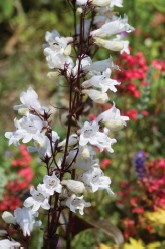 iStock | gardendata
Other microclimates and conditions
A number of unique microclimates were observed on the green roofs, such as intermittent shade, localized incidental moisture, mechanical damage and increased fertility. The green roof gardens received full sun throughout the year except for an area along the southern edge of the north roof where the shadow from the atrium clerestory created some shade. The shadow was at its narrowest in mid- to late June, when only a few inches of shade was provided, and up to four feet wide when the sun was lower in the sky.
A few taxa were specifically sited to take advantage of the shade – Hosta ‘Cracker Crumbs’, Hosta lancifolia, Pachysandra procumbens, and Sedum ternatum ‘Larenim Park’. Shade encroached on a number of other taxa at various times in the growing season, resulting in a portion of the shaded plants being larger and lusher than their counterparts in full sun. In these cases, plant size differences ranged from slight to significant for the following taxa: Calamagrostis brachytricha, Calamintha nepeta ssp. nepeta, Gypsophila repens ‘Roseum’, Hosta ‘Cracker Crumbs’, H. lancifolia, Koeleria glauca, Perovskia atriplicifolia, Prunella grandiflora, Sedum ternatum ‘Larenim Park’, Sesleria caerulea, and Solidago ‘Wichita Mountains’.
Conversely, a few of the taxa that received intermittent shade had plants that were smaller, looser and less vigorous in the shade than in the sunny areas, including Antennaria dioica, Eriogonum umbellatum, Lavandula angustifolia ‘Hidcote’, Linum flavum ‘Compactum’, Scutellaria alpina and Sempervivum ‘Le Clair’s Form’.
Lupinus perennis and Asclepias tuberosa were the only two taxa that died out completely in the first winter of 2009-10. In both instances, the original plants were weak when planted, and while many did not survive transplanting, the remaining plants succumbed to winter conditions. Both taxa were replanted in May 2011, and although most of the Asclepias tuberosa survived the replanting, none of the Lupinus perennis survived for more than a few weeks.
Some taxa were not well-suited to the environment and growing conditions on the green roofs, resulting in the gradual to rapid decline of plant health and eventual death before the end of the trial. Generally, these taxa lacked vigor or remained small, and in many cases, gradually died out over successive winters. The 30 taxa that did not complete the trial are noted in the full report.
Pest threats
Diseases and pests were fairly insignificant considering the variety of taxa and the sheer number of plants on the green roof. Powdery mildew, rust, leaf spot, phomopsis blight, aphids and lace bugs were the only problems observed. Minor powdery mildew was observed in multiple years on Monarda fistulosa, Penstemon digitalis, P. hirsutus, Symphyotrichum novae-angliae and S. oolentangiense. Only penstemons were troubled by foliar rust, with varying infection rates noted on Penstemon digitalis (minor), P. digitalis ‘Husker Red’ (severe), P. grandiflorus (moderate), P. grandiflorus ‘Prairie Snow’ (minor), P. hirsutus (minor to moderate), and P. hirsutus ‘Pygmaeus’ (minor).
A variety of plants were affected by bacterial or fungal leaf spotting including Fragaria virginiana, Hosta lancifolia, Potentilla arguta, Rudbeckia fulgida and Symphyotrichum novae-angliae. Juniperus horizontalis ‘Wiltonii’ was periodically troubled by phomopsis tip blight (Phomopsis juniperovora), but J. chinensis var. sargentii ‘Viridis’ was not. Spider mites were an occasional pest on Asclepias tuberosa, ranging from insignificant to severe infestations depending on the year. Chrysanthemum lace bug (Corythucha marmorata) attacks a variety of ornamental plants in the Aster family, such as chrysanthemums, asters, goldenrods, sunflowers and black-eyed susans, and was by far the most significant pest issue for Ratibida pinnata, Solidago rigida, Symphyotrichum ericoides, S. novae-angliae and S. oolentangiense. Infestations were typically severe, resulting in sickly foliage and weakened health.
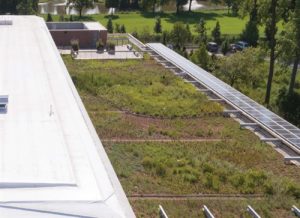
Photo courtesy of Chicago Botanic Garden
Winter loss
Data collection began in April 2010 with an assessment of plant losses during the first winter of 2009-10. Of the original 35,988 plants planted in 2009, approximately 25 percent died during the first winter. In subsequent years, winter losses were never as great as the first winter; winter losses in later years were more commonly associated with weakened plant health due to environmental causes such as drought-stress rather than cold hardiness. In the spring of 2011, plants were added to several winter-decimated plots on the north green roof.
Snow and ice build-up was typically noted along the shaded edge of the north roof for several weeks longer in the spring than in other sections of the green roof; up to six feet into the bed could be covered. This phenomenon caused plants in this area to develop much later than plants growing just feet away. In addition, frost heaving and winter-desiccation were consistent problems for Armeria maritima ‘Alba’, A. maritima ‘Rubrifolia’, Aster oharai, Erigeron caespitosa, E. scopulinus, Penstemon grandiflorus and P. grandiflorus ‘Prairie Snow’. In some years, Heuchera richardsonii and H. micrantha ‘Palace Purple’ were affected to a lesser degree.
Adding color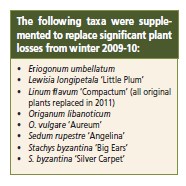
Like any perennial garden, floral displays are vital on green roofs, too. An assessment of floral traits includes flower color, flower size, bloom period and flower production. Many taxa had exceptional floral displays, which enhanced the ornamental aspect of the green roof in spring, summer and fall. Early bloomers such as Viola sagittata, Antennaria dioica, Geum triflorum, Dianthus gratianopolitanus ‘Firewitch’, Phlox bifida, Tetraneuris herbacea, Tradescantia tharpii and cultivars of moss phlox (Phlox subulata), brought the green roof to life beginning in late April and early May.
Summer-flowering perennials provided the longest bloom periods, from June through August. Among the best shows of the summer-flowering taxa were Agastache foeniculum, Amorpha canescens, Bouteloua curtipendula, Calamintha nepeta ssp. nepeta, Coreopsis lanceolata, Dalea candida, D. purpurea, D. villosa, Koeleria glauca, K. macrantha, Penstemon digitalis, P. hirsutus and P. hirsutus ‘Pygmaeus’.
A variety of grasses added greatly to the late season show along with perennials such as Helianthus mollis, Hosta lancifolia, Hylotelephium ‘Rosy Glow’, Lespedeza capitata, Liatris ligulistylis, Salvia azurea var. grandiflora, Solidago rigida and Solidago ‘Wichita Mountains’.
Self-perpetuation
Plant survival on a green roof is due in part to its ability to perpetuate itself, whether by seed or by vegetative means such as rhizomes, stolons or suckers. Whether or not a plant was considered weedy depended on the rate and degree that it spread. None of the vegetative-spreaders in the trial were considered weedy or overly troublesome, at least in the way they were used here. In fact, a number of rhizomatous species were wide-spreading but did not form dense plantings. Artemisia ludoviciana var. albula ‘Silver King’ had a loose rhizomatous habit that worked well mixed with Dianthus gratianopolitanus ‘Firewitch’, where its silvery foliage created a nice contrast but it did not out-compete the dianthus.
Helianthus mollis also had a loose rhizomatous habit, forming a plot of single-stemmed to somewhat bushy plants; its potential to be too wide-spreading and potentially troublesome was noted. Rather than forming discrete clumps, Monarda fistulosa remained loosely stoloniferous. Fragaria viriginiana displayed a robust stoloniferous habit early in the season but the stolons were usually killed during periods of extreme heat and drought. Conversely, Fragaria ‘Stickbolwi’ never formed stolons during the trial, so its effectiveness as a groundcover was limited. Rosa carolina had a suckering habit that formed a thicket between the original plants, but as of 2014 the offshoots had not become problematic to nearby plantings.
Weediness is a nuisance on any green roof, but on a managed roof reseeding or spreading can be kept in check. However, on an unmanaged green roof, the proliferation of one or more species can overrun the roof, smothering or 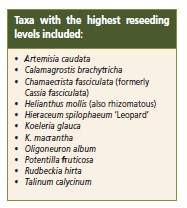 out-competing desirable plants and decreasing the diversity of the planting.
Along with observing how prolifically and quickly a plant spread by seed, we also observed the pattern of dispersion or movement on the green roof. Plants were regularly monitored for seedling production to determine the degree of aggressiveness or weediness.
Despite heavy seed production on all of these taxa, the most aggressively weedy and/or wide-spreading of these species were Chamaecrista fasciculata, Hieraceum spilophaeum ‘Leopard’, Koeleria glauca, K. macrantha and Oligoneuron album.
Koeleria glauca and K. macrantha were grown on different roofs but acted in the same way by filling any open space with seedlings. Chamaecrista fasciculata is an annual species that produced an abundance of lush seedlings each spring, most arising in the same location as the previous year but some seedlings came up several feet away. C. fasciculata was unique in that it did not spread far but its countless seedlings formed a dense mass that smothered all nearby plants.
Rudbeckia hirta is a short-lived perennial that effectively acted like an annual on the green roof. In fact, it was originally planted as a seasonal display for the opening of the green roofs in 2009, but perpetuated itself quite fruitfully during several years of the trial, dispersing widely across the green roof.
Artemisia caudata is a biennial that produces a rosette of basal leaves the first year and a flowering stem the second year before dying out. Although quite a prolific reseeder, the seedlings did not travel far from the original plants. Seedlings of Calamagrostis brachytricha were not an issue in the growing beds, but each spring an immeasurable number of seedlings blanketed the gravel path adjacent to the planting bed.
In a few cases, taxa planted on the north green roof were eventually observed on the south green roof, including Dianthus carthusianorum, Leucanthemum vulgare, Hieraceum spilophaeum ‘Leopard’ and Petrorhagia saxifraga ‘Rosea’. Talinum calycinum was the only taxon that was observed moving from the south to the north roof. Several herbaceous taxa were discovered on the south roof, presumed to have seeded in rather than arriving with the original plants, including Veronica spicata, Lobelia spicata and Coreopsis tripteris. In addition, a number of woody plants seeded in at various times over the course of the trial, including Salix sp., Alnus hirsuta, Crataegus phaenopyrum, Acer negundo, Populus deltoides and Fraxinus pennsylvanica. Woody plants were generally not suited to the growing conditions and did not thrive.
More of this report, including site and study specifics and information on those plants that did not fare well, can be viewed online at http://www.amerinursery.com.
Cover Photo courtesy of Chicago Botanic Garden
The post UP ON THE ROOF appeared first on AmeriNursery.com.
]]>The post TROPAEOLUM appeared first on AmeriNursery.com.
]]>
Yes, it’s an annual. But Tropaeolum, commonly known as nasturtium, neatly bridges the gap between ornamental and edible, and may be just the plant that ties together the garden that’s created to offer both beauty and bounty.
For today’s – and tomorrow’s – gardeners who are demanding “purpose” in the landscape, nasturtium provides lovely color all season long, plus an unusual and striking garnish at the dining table. Both the flowers and the foliage are often used in salads, dressing up that plate full of greens. The foliage can also be prepared much like spinach, either fresh or cooked.
Name: Tropaeolum
Common name: Nasturtium
Hardiness: Annual
Mature height: 12 inches to 10 feet
Mature spread: 1 to 3 feet
Classification: Annual pot or garden plant
Landscape use: Grow in containers and allow to trail; use as a quick-growing groundcover or train the trailing variety up a fence or garden obelisk
Ornamental characteristics: Very showy, fragrant, funnel-shaped, fivepetaled flowers sport spurs; blooms range from red through orange to yellow and cream and grow to about 2.5 inches wide; rounded foliage; climbing and bushy, sprawling types are available
Some folks even eat the seed pods, although I once was warned to stay away from seeds, as a few questionable sources report they contain toxic elements. (Maybe that’s why Dad called them “nasty little nasturtiums.” On the other hand, he was given to wordplay, so you never know. He was known to pluck the plant, flower, stem and leaf, and munch it before he left the garden.) And in case you’re concerned about your pets, the ASPCA reports that there’s no evidence of toxicity to dogs, cats or horses.
The flavor varies slightly from garden to garden, but very slightly. (A neighbor, whose soil is similar to mine, offered some extra nasturtium and they were tangier than the crop I’d grown. Perhaps a different seed strain?) Washed flowers and leaves offer a subtle, peppery taste; certainly not overwhelming, but enough to spice up a salad. Some liken the flavor to a radish, although I’ve found them to be a bit wimpier than that. Stems may be slightly sweet at first, then the aftertaste is strongly peppered. I’ve only used nasturtiums in fresh salads, primarily because I’m an admittedly lazy cook. If it takes much preparation, I’m not interested.
So, that’s the table; what do nasturtiums contribute to the garden?
Phots: iStock | morgana3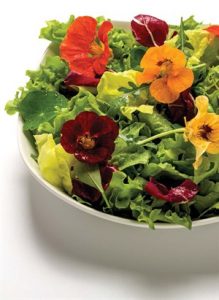
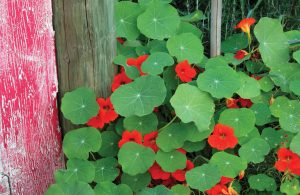
It’s hard to miss the brilliantly colored, showy blooms, offered in sunny colors ranging from red to orange to yellow, and sometimes cream. The funnel-shaped blooms, which have five petals and are spurred, sit atop rather long stalks. Many varieties have a spicy scent.
The unique foliage is rounded and presents itself like a parasol, with the petiole attached near the center of each leaf. Most leaves grow to about 3 to 4 inches round, but I’ve had several plants whose leaves have exceeded 5 inches – perhaps they were garden freaks.
There are quite a few varieties, most of them falling within two categories of growth habit: climbing types and bushy, sprawling types. It’s really just a matter of site conditions, as both types require similar care. Average to poor (!) soils are tolerated, and some afternoon shade is welcome in regions where summers tend to experience prolonged heat. The plants are not susceptible to significant insect or disease problems, although the occasional whitefly or aphid infestation may occur.
Nasturtiums grow quickly, offer color and rich foliage in container or garden settings, and provide a bit of Vitamin C, to boot. They’re the ideal starter plant for those who want more than aesthetics in the landscape. They’re plants with a purpose.
Cover Photo iStock | DaveAlan
The post TROPAEOLUM appeared first on AmeriNursery.com.
]]>