The post SHIFTING PERSPECTIVES appeared first on AmeriNursery.com.
]]>
The Greatest Generation. Baby Boomers. Gen X. Gen Y. The Millennials. (Youngest cohort to be determined.)
At any point in time, our population is composed of several generations – living together, working together, moving society forward and fighting like cats and dogs. Looking back through history, however, it’s easy to see that this century is unique: Never before have so many representatives of so many generations coexisted.
As has been the case for centuries, each consecutive generation tends to confound the one that came before. We’re left scratching our heads, wondering what happened and why these kids don’t think and act the way we do. Their point of view – their worldview – is quite different. Their habits don’t mirror ours. Their demands reflect what we perceive to be different values.
Photos courtesy Sally benson unless otherwise noted
But are they really so disparate? Yes. No. Maybe? Take the Millennials, the group of young adults who now compose the largest, most diverse generation in the U.S. Their education and their understanding of the world have been shaped by technology that simply didn’t exist for previous generations. According to research conducted by the President’s Council of Economic Advisors, as well as Pew Research, Gallup polls and far too many studies to list here, members of this generation – in general – tend to value community, family and creativity in their work. Despite the embrace of “family,” however, they tend to marry later than those in previous generations, and they’re putting off home ownership longer than their Gen Y, Gen X and Baby Boomer relatives.
All of this presents a challenge to the green industry, and the rise of the Millennial Generation comes at a time when we’re reevaluating our business protocols following the Great Recession. While it may not represent a seismic shift in the industry, it’s time to shift perspectives and discover the best ways to reach a changing client and customer base.
But how?
Enter SHIFT, the research initiative launched this year through the joint efforts of AmericanHort and the Horticultural Research Institute. It’s a multiyear project tasked with the goal of determining who this generation is, what they want, and how we need to shift our business mindsets and practices in order to capitalize on the opportunities presented by changing consumer demographics and behaviors. It’s a tall order, but it’s a necessary step. This is a huge population of consumers whose shopping and lifestyle habits are very different from what we’re used to addressing.
The research process
Field research began in 2014 and enlisted students in the MindMarket program at the Columbus College of Art and Design. Beginning with the question, “What if … ?” researchers dug deep into the industry’s current business models, utilizing a process called “design thinking,” which employs typical design practices and merges them with business strategies – which is to say, paying close attention to the end users on the front end, and designing for them. As one student researcher so aptly put it, “The benefit of our research is that we did qualitative research instead of quantitive. A lot of times, people with a business background and a business way of thinking about things are very hard-core about the numbers. The benefit of approaching it from design thinking and a qualitative standpoint is that it opens you up to being able to get in there and experience what the customers experience.”

Photo: iStock | Alberto Bogo
Researchers spanned the country to partake in the garden center experience in all regions, determining what worked and what didn’t. Sort of like a secret shopper? Maybe. Once they gathered ideas, they developed “design maps,” which basically serve as suggestions and recommendations to retailers about how to improve the experience – from the young shopper’s point of view. What’s confusing? What’s daunting? What’s boring?
What works? It’s a fresh new perspective that connects the retailer with the purchaser – and from there, the rest of the industry benefits from these insights. The program began with a concentration on retail, but it was soon realized that each segment can and should be addressed.
In a nutshell, “design thinking” is solution-focused exploration. Rather than begin with a negative, a problem – say, “we’re slow to recover from a recession and we’re concerned about where we go from here” – it begins with the ultimate goal in mind: How do we attract new customers? How do we express the value of plants in the new customers’ language?
Early results
Much of this initial work – remember, this project will span several years – was revealed at Cultivate’15 in Columbus in July, where graphic presentations were offered to help industry professionals become attuned to the rising tide of new consumers. For example, researchers suggested that language, including industry specific lingo, often can be intimidating. To many, “gardening” means work. And newer consumers are drawn to ultimate value rather than what goes on behind the scenes, so rather than discussing “weeding,” they respond to the results. It’s “spring cleaning,” it’s a “facelift,” it’s anger management therapy. (Haven’t we all been there?)
Photo: iStock | michaeljung
Visitors were encouraged to offer alternatives to the title, “gardener,” and among the typical suggestions of plant geek, plant nerd and landscape designer were “outdoor living specialist,” “eco-tarian” and “horticultural astronaut.”
The research continues, with the goal being to provide industry professionals new ways to shift their thinking and, ultimately, to adapt new business models to become more successful in reaching the newer generations who expect something different from the status quo.
They say you can’t teach an old dog new tricks, but you can certainly learn to adapt your business when the research shows what works.
More information can be found at the AmericanHort site, http://www.americanhort.org, with updates promised as the project continues.
Cover Photo: iStock | michaeljung
The post SHIFTING PERSPECTIVES appeared first on AmeriNursery.com.
]]>The post GROW WISE, BEE SMART WEBSITE LAUNCHES appeared first on AmeriNursery.com.
]]>
The Horticultural Research Institute, the research affiliate of AmericanHort, announced the launch of the Grow Wise, Bee Smart website. This resource is a key component of the Horticultural Industry’s Bee and Pollinator Stewardship Initiative, which was created to provide leadership and guidance to the industry on pollinator health. The site serves as the communications hub for the latest research and developments related to the role horticulture plays in supporting pollinator health.
Grow Wise, Bee Smart currently features information on the importance of bees and pollinators, threats to their health, and steps everyone can take to improve habitat and forage. Links to the Million Pollinator Garden Challenge and Pollinator Partnership further guide retail and landscape firms and their customers on how to plant and register new gardens and habitats for pollinators.
As the Grow Wise, Bee Smart stewardship program for plant production is launched, and as funded and directed research yields results and guidance, the site will feature timely new information and insights.
The Horticultural Industry’s Bee and Pollinator Stewardship Initiative has three goals:
- fund and guide research to answer urgent questions regarding impact of pest management practices and bee and pollinator attractiveness of major plants we grow and sell;
- develop a plant production stewardship program based on best practices; and,
- partner with other interested groups to improve and expand pollinator habitat and forage.
Great progress is being made on all fronts. The Horticultural Research Institute has directly funded five related research projects totaling $160,100. AmericanHort and HRI helped to secure another $272,000 for a priority project that received special Farm Bill funding. A grower and scientist task force has developed key components for the stewardship program. And, AmericanHort was one of eight founding partners of the National Pollinator Garden Network, which in early June launched the Million Pollinator Garden Challenge.
“Horticulture, the health of pollinators, and the success of our industry are intertwined,” said Harvey Cotten, past president of the Horticultural Research Institute and a leader in the Bee and Pollinator Stewardship Initiative. “We are the original green industry, and our plants and expertise can make a difference for bees, butterflies, and other pollinators,” he added.
The post GROW WISE, BEE SMART WEBSITE LAUNCHES appeared first on AmeriNursery.com.
]]>The post DISEASE MANAGEMENT ISSUES AND PRACTICES IN MID-ATLANTIC NURSERIES appeared first on AmeriNursery.com.
]]>
Irrigation water quality and efficient use of irrigation water are ongoing concerns for horticultural firms in the U.S. and across the globe. As competition for scarce water resources increases, risks of water shortages will also increase. As every nurseryman knows, access to sufficient safe irrigation water is a necessity, not an option. In addition, increasing attention is being paid to the quality of water runoff from irrigated agriculture. Irrigation water recycling is a practical step that businesses can use to improve water use efficiency. However, recycling can be costly, not only in terms of infrastructure but also of increased potential for disease pathogen buildup.
In response to these issues, the USDA Specialty Crop Research Initiative (SCRI) funded an integrated research and extension project (USDA Irrigation Pathogens and Water Quality #2010-51181-21140) involving seven universities that is designed to improve water use efficiency and protect the health of ornamental crops. Project objectives include the development of Best Management Practices (BMPs) to increase water recycling on horticultural operations and to mitigate water quality- related crop health risks. (More information on the project is available at http://www.irrigation-pathogens.ppws.vt.edu/.)
The project’s economics team surveyed Mid-Atlantic nursery growers in 2013 (see sidebar). The current article focuses on disease management practices and investigates the relationship between disease risk, disease management and recycling practices. The survey results indicate that nurseries are primarily concerned with financial risks resulting from disease outbreaks and insect infestation. Despite disease concerns, nurseries that recycle at least a portion of their irrigation and storm water runoff appear to have been more successful in avoiding major disease losses. Growers who currently do not capture and recycle consider high costs, increased disease risk and unsuitability of the nursery layout to be the principle barriers to recycling. The article also briefly discusses the project’s recommendations of best management practices for irrigation and disease management for recyclers and nonrecyclers alike.
Disease and insect infestation stand out among financial risk factors
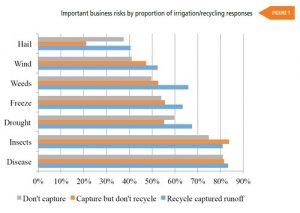
Our project is particularly concerned with disease risks to nurseries. Respondents were asked to rate the individual importance of various threats of financial loss to their business: disease, drought, wind, frost, weeds, insects and hail. The responses were selected from an increasing scale ranging from “not important” to “very important.” Figure 1 shows the proportion of responses indicating that a threat was considered “important” or “somewhat important” by irrigation/recycling type and for all responding nurseries.
Across all nurseries, disease and insects are the causes of financial loss that approximately four in five respondents consider to be somewhat or very important. By irrigation/recycling type, a higher proportion of recyclers regard nearly every threat (except insects) as more important than do other types of nurseries. In general, however, there are only relatively small differences by irrigation/recycling type in the proportion of nurserymen considering a particular risk to be important.
Disease management priority varies by irrigation/recycling category
In a subsequent question, respondents were asked to rate disease risk as a day-to-day management priority. Of 252 responses, 50 percent rated disease risk management as a “very important” priority (results not shown). However, the perceived importance of disease management as a priority differed somewhat across irrigation/recycling category. Respondents who capture runoff but don’t recycle were more concerned about disease management; 69 percent regarded disease management as a very important priority, as opposed to 63 percent of recyclers and only 58 percent of those who don’t capture. Less concern about disease among recyclers than among those who capture may indicate that they feel more successful at managing disease risk.
Perceived disease risk based on past experience
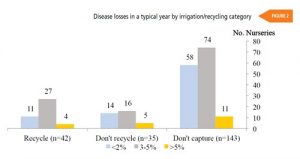
It should come as no surprise that perceptions of disease risk often depend on growers’ previous experience with disease. Across all firms, 83 of 220 nurseries (38 percent) responded that they typically lose 2 percent or less of sales to disease (Figure 2). Twenty nurseries (9 percent) reported typical disease losses equivalent to 5 percent or more of sales. Seven nurseries responded that they typically lose more than 10 percent of sales to disease, and none of these are recyclers. In terms of the maximum sales value ever lost to disease (data not shown), 133 nurseries (51 percent) reported that the maximum loss to disease was less than 2 percent of sales. However, 21 nurseries (10 percent) reported a maximum loss in excess of 10 percent of sales, and only one recycling nursery was among this high maximum loss group. In contrast, 13 nurseries that do not capture or recycle reported maximum losses in excess of 10 percent of sales. Recyclers appear to be more successful at managing extreme disease losses compared to other nurseries.
Phytophthora and Pythium
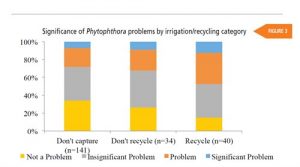
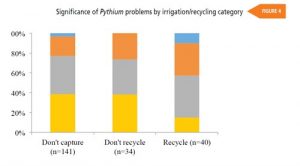
There are many disease vectors of ornamental plants; for example, insects, fungi, bacteria and viruses. Our project is focused on two important sources of ornamental plant disease: Phytophthora and Pythium (see sidebar). Application of untreated irrigation water carries the risk of introducing such waterborne pathogens. These risks increase when irrigation runoff is recycled. Once disease pathogens have entered a system, recirculated water can inoculate plants repeatedly. To evaluate the concern with Phytophthora or Pythium infestations, we asked survey respondents whether each pathogen was “not a problem,” an “insignificant problem,” a “problem” or a “significant problem.” Overall, 34 percent of nurseries considered Phytophthora as a problem or a significant problem, while 27 percent regarded Pythium as a problem or a significant problem. Recyclers had more problems with Phytophthora, with 48 percent of recyclers reporting disease caused by that pathogen as a problem or a significant problem, and 43 percent reported the same for Pythium. Figures 3 and 4 display how recyclers are more concerned about both these diseases, which is consistent
with the expectation that waterborne disease outbreaks are a persistent threat in recycling irrigation systems.
Disease prevention is important to nearly all nurseries
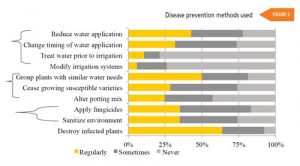
Respectively, 93 percent of recyclers, 83 percent of those who capture but don’t recycle, and 87 percent of those who don’t capture consider disease management and prevention to be important or very important. If disease risk is so important, why do responding nurseries indicate relatively few problems with the major diseases caused by Phytophthora and Pythium? An explanation may be found in the management activities employed to prevent disease damage (Figure 5).
Most respondents (61 percent) indicate that they regularly destroy potentially infected plants to prevent disease, and a somewhat higher proportion of recyclers (71 percent) report regularly using this practice. This “after the fact” disease management does not require knowledge of specific causes of disease, such as Pythium and Phytophthora. Higher plant destruction among recyclers likely is associated with their increased concern in avoiding disease risks. Overall, recyclers differ from non-recyclers in disease prevention methods only in their regular treatment of irrigation water (26 percent vs. 7 percent) and their use of fungicides (50 percent vs. 32 percent). Other methods regularly used by many growers to prevent disease include grouping plants with similar water needs, reducing water applications, or sanitizing the environment. Only a small proportion of respondents (6 percent) report having modified their irrigation system for disease prevention.
“State of the industry” for disease management and irrigation practices
Disease management
Because disease is reported as a principle source of financial risk, it’s not surprising that most businesses indicated that disease prevention was an important daily management activity. Across irrigation/recycling categories, 83 to 93 percent indicate disease prevention activities as “very important.” Nurseries manage disease risk through a combination of practices associated with runoff water treatment, irrigation water treatment, and other practices. If a threat of disease is suspected, virtually all nurseries are ready to apply chemicals for control of fungal diseases.
Runoff water treatment methods
Water treatment is conducted at various stages in the production process. In some cases, source water (such as well water) is treated prior to application. After watering production areas, captured runoff water is generally treated in some manner prior to either release or reuse. Treatments may differ depending on the intended water use; generally, runoff captured and re-applied to plants requires more treatment than runoff to be discharged. Treatment differences reflect differing objectives: Discharge water is generally treated for environmental reasons (for example, to control downstream nutrient levels) and/ or to comply with discharge regulations, whereas treatment of water intended for reuse is generally for disease mitigation. The survey distinguishes between methods used for treating runoff prior to capture or discharge (such as buffer strips, wetlands or erosion controls) and methods for treating irrigation water (such as chlorination or sand filters).
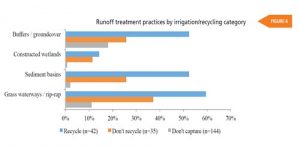
Figure 6 shows the proportion of respondents in each recycling category using each runoff treatment practice. Survey data indicate that a larger proportion of recyclers than other recycling categories utilize each runoff treatment. The majority of recyclers use buffers or groundcover, sediment basins, or grass waterways or rip-rap to runoff treatment. A small proportion of respondents also reported using other methods, such as erosion control and critical area stabilization (not reported in figure).
Nurseries that don’t capture runoff utilize relatively few runoff treatment practices, with buffers or groundcover used by only 18 percent of nurseries. Many nurseries that don’t capture reported using no runoff treatment practices. Runoff treatment is an important practice for state and federal water quality programs such as the Chesapeake Bay “pollution diet” established by the EPA ( http://www.chesapeakebay.net/blog/post/epa_establishes_chesapeake_bay_pollution_diet). Nurseries that do not capture or treat runoff are likely to receive increased attention from environmental agencies.
Irrigation water treatment
Fully 75 percent of the 259 irrigating nurseries used no form of irrigation water treatment. Nontreatment is closely associated with irrigation water drawn from wells, which is particularly common on small and medium nurseries. It should cause no surprise that recyclers are the most intensive users of irrigation water treatment methods. Chlorine or other disinfectants such as bromine were the most commonly used treatment methods. This likely reflects a cost advantage for disinfectants relative to other treatment methods. The second most common method was utilization of a sand filter. Only a few instances of other methods such as ultraviolet light or dye were reported.
Other practices to manage risk of waterborne diseases
A recommendation by the Irrigation Pathogens and Water Quality Project to reduce risk of Pythium and Phytophthora infestation is to prolong water residence time in storage prior to reuse. Nurseries in the survey were asked to indicate if they had received and implemented recommendations to adjust the number and size of collection ponds, alter water conveyance or alter pump location in order to reduce the potential for diseases caused by these pathogens. Responses indicated that fewer than 10 nurseries had implemented such a recommendation. The Project will be investigating further to estimate implementation costs of these cultural practices.
Costs of disease treatment
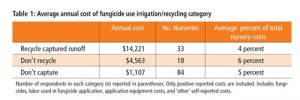
Left untreated, fungal diseases can destroy large portions of a nursery crop. A sometimes critical element of disease management is the application of fungicides. Seventy-four percent of surveyed nurseries applied fungicides. Table 1 shows average costs of fungicide materials, labor and equipment in dollars and as a percent of total nursery costs for those who responded to these questions. The data show that nurseries generally spend a higher proportion of total costs on fungicide applications than on water treatment. Although recycling nurseries reported higher fungicide costs than nonrecyclers, the average fungicide expenditure as a proportion of total costs is similar across irrigation categories, ranging from 4 to 16 percent.
What we learned
Survey results suggest that disease is considered to be a top financial risk for ornamental plant growers. Across the spectrum of recycling categories, disease is consistently viewed as a key source of financial risk, but disease is a relatively greater concern for growers who currently capture at least some production runoff, but do not recycle. In contrast, the recycling nurseries appear to be more successful in disease management and have experienced a lower incidence of major disease losses. The data suggest that while disease risk is perceived to be a barrier to recycling, that risk is well managed by recyclers who use water treatment and disease management practices.
The aim of the irrigation pathogen project is to assist growers to adopt “pre-emptive” disease management measures rather than relying on costly reactive measures (destroying plants). The project offers research-based advice on best management practices for irrigation and recycling system design and operation in order to minimize disease risk in ornamental plant operations.
Gwendolyn Rees is a research assistant in the Department of Agricultural and Applied Economics at Virginia Tech University; she can be reached at [email protected]. Alyssa Cultice is an Environmental Scientist at PG Environment LLC in Herndon, Virginia; she can be reached at [email protected]. James Pease, Darrell Bosch and Kevin Boyle are Professors in the Department of Agricultural and Applied Economics at Virginia Tech University; they can be reached at [email protected], [email protected] and [email protected], respectively.
References
Cultice, Alyssa K. 2013. Horticultural Producers’ Willingness to Adopt Water Recycling Technology in the Mid-Atlantic Region. M.S. Thesis. Department of Agricultural and Applied Economics, Virginia Tech, Blacksburg, Virginia. July 7, 2013. Retrieved from http://hdl.handle.net/10919/49455.
Hong, C. X. 2014. Component analysis of irrigation water in plant disease epidemiology Page 111- 121 In: Biology, Detection and Management of Plant Pathogens in Irrigation Water. Hong, C. X, Moorman, G. W., Wohanka, W. and Buettner, C. (eds.) American Phytopathological Society, St Paul, MN
Moorman, Gary. “Phytophthora Root Rot on Woody Ornamentals”. Penn State Extension. (2010a). Retrieved from http://extension.psu.edu/pests/plant-diseases/all-fact-sheets/phytophthora- root-rot-on-woody-ornamentals
Moorman, G. “Pythium”. Penn State Extension. (2010b). Retrieved from http://extension.psu.edu/plant-disease-factsheets/all-fact-sheets/pythium
The post DISEASE MANAGEMENT ISSUES AND PRACTICES IN MID-ATLANTIC NURSERIES appeared first on AmeriNursery.com.
]]>