The post BEFORE AND AFTER appeared first on AmeriNursery.com.
]]>
What a mess.
When retired police officer Richard Coates hired a landscape company to renovate his southern California back yard, he was careful to verify the company’s licensing as well as its portfolio. He accompanied the owner on a tour of previous job sites and was impressed with the quality of work. Everything appeared to be legit. This was not just two guys and a pickup; it was an established company, with the current owner having taken over for his father. “He was a really nice guy,” Coates adds. It all looked good.
That is, until work began.
When the original demolition crew was dismissed, the pool hadn’t been drained.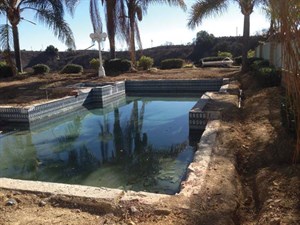
Renovation interrupted
Having lived in his home for about 20 years, Coates had decided it was time for a backyard update. The pool needed to be repaired and its concrete deck was cracked; the patio cover hosted dry rot and termites, and it was time for a new entertainment center and outdoor kitchen. “We were really going to do it up right,” Coates says.
Coates visited the website Houzz.com and reviewed a number of offerings before he selected his favorite. “The work that he had done was pretty much exactly what we were looking for,” Coates explains. “He was a local guy, he did great work. So we met with him, and he seemed like just the super nicest guy.
“I checked his license on the Internet,” he continues. “He said he’d come over with some plans and a contract. Now, I don’t know a whole lot about contracts or what a contractor can or cannot do, or what they require or what they don’t require. But we signed the contract and he asked for an initial down payment of $6,000. Subsequently, I found out that he can’t do that.”
So far, none of this sounds unusual. Homeowners searching for professionals can turn to myriad sources, including the Web, and this particular client did exactly what so many do. In fact, he was careful to go further than many laypeople do – he’d done some construction work back in the day, so he was familiar with licensing and with many of the technical aspects of demolition.

Before – The old pool needed updating and repair; following a rocky start, the new water feature is a highlight of the property for the homeowners, their friends and family.Photos courtesy of Snyder & Associates
“The guy seemed really squared away,” Coates claims. “Maybe a little later on in the project I thought, this is getting a little out of control. But we started demo the next day, everything seemed to go okay, and I met that benchmark payment.”
The next step was installing drainage lines, and here’s where the project began to go downhill – fast.
“I noticed that these guys didn’t even have a set of plans,” Coates explains. “It was just a little piece of paper with some rough drawings. I knew a little bit about how you have to shoot elevations, and you have to have a set of plumb lines. So they start putting in the drains, and I can see right away that it’s completely wrong.”

After.
Coates stopped the workers, phoned the contractor and told him that he or his project supervisor needed to make a site visit. “So he came out one day and started them off again, kind of got things going in the right direction, but three days later, I get a knock on my front door and it’s the demo guy. And he says, ‘Hey, I haven’t been paid.’ And by this time, I’ve given the contractor close to $30,000.”
Excuse after excuse
Despite the on-time receipt of “benchmark” payments, the contractor simply wasn’t doing the job – and he wasn’t paying his subcontractors. Coates says he assured the demo worker that he’d get paid – “it’s only fair, because he did the work” – and then he tried to track down the contractor, who avoided calls, emails and text messages. After repeated attempts, they connect. “I tell him the demo man was over here, and he says you haven’t paid him. So [the contractor] says, ‘Oh, well, one of my other clients, they were supposed to give me a check, but they were out of town; don’t worry about it’ … blah, blah, blah.”
Should it be the homeowner’s responsibility to follow up? “I did think that was a little unusual, but I’m still thinking this guy’s okay,” Coates admits. A successful contractor is a busy contractor, after all. Then: “I tell him that his guys are over here working and they don’t even have a set of plans. How do you expect them to build something without any plans? And he says, ‘Well, I’m trying to set up some forms … and my designer, he just had a baby … ‘ and this guy’s got an excuse for everything.
“So then they start putting in the forms, and he takes another payment,” Coates continues. “By now he’s got about $38,000, $40,00 from me, and all I’ve got is a torn up back yard. I’m watching them from inside the house and they do the whole thing wrong. Completely, totally wrong from what my design was going to be.”
Once again, the contractor is called. He assures Coates the project supervisor will arrive. The next day, workers show up, and there’s no supervisor. Coates says he asked them, “Hey, where’s Fernando? And they say, ‘Oh, he couldn’t come today.’ So I said fine, pick up all your tools and get off the job; you’re done here.”
Another call to the contractor, who, not surprisingly, doesn’t respond. “So I start digging a little deeper,” Coates says, “and I find when I check his license, it had been suspended the day before he came over to my house to sign and contract and take my money. I mean, the day before. He lost it because he lost his workers’ comp and he didn’t have his bond.
“Now I’m thinking,” he adds, “I’m really screwed, because this guy’s got about $40,000 of mine. I had checked his license before [we met], but in the interim, that quickly, he’d lost his license. And all the while I’m saying to him, ‘Now listen, I don’t want my money going to pay some other jobs.’ And he’s saying, ‘Oh, no, no, I’ve got an account that’s dedicated to your job, don’t worry about any of that.’ “
Calling for reinforcement
Beyond frustration, out tens of thousands of dollars and left with scorched-earth property, Coates decided to switch gears. Through word of mouth he was referred to Kerry Snyder, who “was more than helpful,” he emphasizes. “I ran the story by him and he said there’s so many things that [the contractor] did that were not legal, and here’s some court cases that you can present to him so that you can show him you’ve done your homework, and that you know that what he did was not right.”
Kerry Snyder says this isn’t all that unusual. Snyder, who with his partner owns Snyder & Associates in Orange, California, says that he’s a “registered landscape architect who’s gone over to the dark side.”

A permanent, covered entertainment center, featuring a fireplace and large-screen TV, anchors the new backyard retreat.
Coates’ project is a good example of why Snyder calls it the “dark side: Because we’re constantly getting calls from clients like this,” who need to be rescued from a bad situation.
“This has happened more than once, where we enter a project and what we see has happened is that demolition has been rushed into,” Snyder says. “On this particular case, demo had been done, they’d already started some excavation for drain lines, so we’d already heard that drains were going in with negative flow. But more so, the moment he told us, well, one of the subcontractors – the builder’s subcontractor – was knocking on the door asking for money, we knew exactly where this was heading. And the other thing was, this particular contractor, we already knew from a couple other project sites that he was having problems. This is not the first job this contractor was doing this to: He’s robbing Peter to pay Paul.”
Snyder first consulted with Coates to help him out of the dilemma, providing Coates with information about licensing. “I know the laws,” he explains, “I know the articles; I gave him the [information] to show the individual. It’s not just for the homeowner to say, ‘I’m going to sue you,’ but here’s proof of what’s going to happen to you.”
In California, Snyder says, an unlicensed contractor who knowingly takes money on the job site can be accused of committing fraud, because he knows he’s not licensed to perform the work. More to the point, an unlicensed contractor wouldn’t be able to pull permits legally – and this contractor’s license had been suspended by the state.
Coates arranged to meet with the contractor, who arrived at the job site with more excuses. He didn’t have the plans because they were still at the printers … he was going through a divorce …
Enough, Coates told him. Armed with Snyder’s information and the implied threat of legal action, Coates negotiated a settlement. First, he says, “I told him you make sure you pay the demo guy, and then you’re going to give me back every penny.” Surprisingly – despite a series of excuses and delays, including an arranged meeting at the bank, where the contractor showed up with $24,000 in cash – Coates recovered his initial investment.
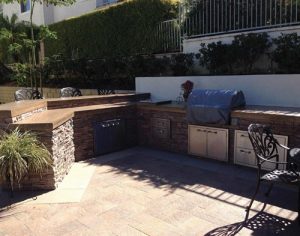
A new outdoor kitchen features stone veneer and polished, poured-in-place concrete countertops.
Wait … what about the project?
With the dismissal of the original contractor, Coates hired Snyder & Associates to complete the job. The design/build contract was similar to the original – minus, of course, the illegalities – entailing a pool remodel, hardscape throughout the yard, a new deck and covered entertainment area, outdoor kitchen and plantings. “Anything that had to do with the outdoors, we did on this,” Snyder says.
Despite the initial demolition work, there was a bit more to be done. Snyder’s crew had to remove the few drain lines that were installed incorrectly, and then real work began in early spring. The pool was relined and new, poured-in-place coping was installed; grading was altered to allow for a spillway; concrete pavers were set. A new outdoor kitchen was created with block wall and stone veneer, plus poured-in-place, polished concrete countertops. The covered patio structure features a fireplace and large-screen TV.
Coates’ dream back yard – the one that began as a nightmare – now provides exactly what he’d hoped for. He admits that he might have been a little too trusting of the first contractor, but how many homeowners would know what they’re getting into? He has some remarkably patient words for contractors, and for homeowners looking for professionals.
“One thing I think I would have done, when [the original contractor] was taking me around to show me his work, I never talked to the people he worked for. I should have said, take me to a couple of places that you’re currently working on. And I should have spoken with the owners there,” Coates offers. But a word-of-mouth recommendation, he says, saved the project.
“I think word-of-mouth advertising is so much more effective than any other way,” he explains. “I mean, if somebody is able to say, I have this guy, and he is really great, I think that works so much better.
“The thing that I found with Kerry that I didn’t find with the first guy,” he continues, “is that communication between the contractor and the client. I don’t think I ever made a call, or a text, or an email that wasn’t answered. He talked to me right then, or within an hour I had a response from him. To me, that is really, really important, as a client. Even if it’s just a simple little silly thing, if you have that communication and that degree of cooperation between the client and the contractor, I think it just goes miles.”
The post BEFORE AND AFTER appeared first on AmeriNursery.com.
]]>The post TROPAEOLUM appeared first on AmeriNursery.com.
]]>
Yes, it’s an annual. But Tropaeolum, commonly known as nasturtium, neatly bridges the gap between ornamental and edible, and may be just the plant that ties together the garden that’s created to offer both beauty and bounty.
For today’s – and tomorrow’s – gardeners who are demanding “purpose” in the landscape, nasturtium provides lovely color all season long, plus an unusual and striking garnish at the dining table. Both the flowers and the foliage are often used in salads, dressing up that plate full of greens. The foliage can also be prepared much like spinach, either fresh or cooked.
Name: Tropaeolum
Common name: Nasturtium
Hardiness: Annual
Mature height: 12 inches to 10 feet
Mature spread: 1 to 3 feet
Classification: Annual pot or garden plant
Landscape use: Grow in containers and allow to trail; use as a quick-growing groundcover or train the trailing variety up a fence or garden obelisk
Ornamental characteristics: Very showy, fragrant, funnel-shaped, fivepetaled flowers sport spurs; blooms range from red through orange to yellow and cream and grow to about 2.5 inches wide; rounded foliage; climbing and bushy, sprawling types are available
Some folks even eat the seed pods, although I once was warned to stay away from seeds, as a few questionable sources report they contain toxic elements. (Maybe that’s why Dad called them “nasty little nasturtiums.” On the other hand, he was given to wordplay, so you never know. He was known to pluck the plant, flower, stem and leaf, and munch it before he left the garden.) And in case you’re concerned about your pets, the ASPCA reports that there’s no evidence of toxicity to dogs, cats or horses.
The flavor varies slightly from garden to garden, but very slightly. (A neighbor, whose soil is similar to mine, offered some extra nasturtium and they were tangier than the crop I’d grown. Perhaps a different seed strain?) Washed flowers and leaves offer a subtle, peppery taste; certainly not overwhelming, but enough to spice up a salad. Some liken the flavor to a radish, although I’ve found them to be a bit wimpier than that. Stems may be slightly sweet at first, then the aftertaste is strongly peppered. I’ve only used nasturtiums in fresh salads, primarily because I’m an admittedly lazy cook. If it takes much preparation, I’m not interested.
So, that’s the table; what do nasturtiums contribute to the garden?
Phots: iStock | morgana3
It’s hard to miss the brilliantly colored, showy blooms, offered in sunny colors ranging from red to orange to yellow, and sometimes cream. The funnel-shaped blooms, which have five petals and are spurred, sit atop rather long stalks. Many varieties have a spicy scent.
The unique foliage is rounded and presents itself like a parasol, with the petiole attached near the center of each leaf. Most leaves grow to about 3 to 4 inches round, but I’ve had several plants whose leaves have exceeded 5 inches – perhaps they were garden freaks.
There are quite a few varieties, most of them falling within two categories of growth habit: climbing types and bushy, sprawling types. It’s really just a matter of site conditions, as both types require similar care. Average to poor (!) soils are tolerated, and some afternoon shade is welcome in regions where summers tend to experience prolonged heat. The plants are not susceptible to significant insect or disease problems, although the occasional whitefly or aphid infestation may occur.
Nasturtiums grow quickly, offer color and rich foliage in container or garden settings, and provide a bit of Vitamin C, to boot. They’re the ideal starter plant for those who want more than aesthetics in the landscape. They’re plants with a purpose.
Cover Photo iStock | DaveAlan
The post TROPAEOLUM appeared first on AmeriNursery.com.
]]>The post WHITE HOUSE ISSUES NATIONAL POLLINATOR STRATEGY appeared first on AmeriNursery.com.
]]>According to the February 9 Congressional Research Service report “Bee Health: The Role of Pesticides,” “The precise reasons for honey bee loss are unknown.” In fact, science suggests multiple factors for the decline in bee health, including parasites, diet and nutrition, lack of genetic diversity, habitat loss, beekeeping practices, weather and disease.
The White House is attempting to address the issue with its Pollinator Strategy that has three overarching goals:
- Honey Bees:Reduce honey bee colony losses during winter (overwintering mortality) to no more than 15% within 10 years. This goal is informed by the previously released Bee Informed Partnership surveys and the newly established quarterly and annual surveys by the USDA National Agricultural Statistics Service. Based on the robust data anticipated from the national, statistically-based NASS surveys of beekeepers, the Task Force will develop baseline data and additional goal metrics for winter, summer and total annual colony loss.
- Monarch Butterflies: Increase the eastern population of the monarch butterfly to 225 million butterflies occupying an area of approximately 15 acres (6 hectares) in the overwintering grounds in Mexico, through domestic/international actions and public-private partnerships, by 2020.
- Pollinator Habitat Acreage: Restore or enhance 7 million acres of land for pollinators over the next 5 years through federal actions and public/private partnerships.
Talking Points
- The landscape industry supports pollinators through the care of plants in the landscape that are their habitat.
- Landscape professionals practice responsible and vital pest control services that remove pest that are detrimental to the landscape.
- Landscape Professionals use EPA and State registered pesticides, in accordance with application guidelines, to control harmful pests, like ticks, and weeds that cause allergies.
- Many bee colonies are now stable. The U.S. Department of Agriculture (USDA) estimates of overwinter bee colony losses have averaged more than 30% annually in recent years, but many beekeepers have been able to replace lost hives.
- Even though the cause of colony collapse is unknown, there are pests that are attacking honeybees, one of which is the varroa mite. A 2013 joint USDA and U.S. Environmental Protection Agency (EPA) report found the varroa mite as the “most detrimental pest of honeybees.”
Some people have singled out pesticides like neonicotinoids as the primary cause for the decline in bee health, when in fact the exact cause is unknown.
The post WHITE HOUSE ISSUES NATIONAL POLLINATOR STRATEGY appeared first on AmeriNursery.com.
]]>The post SURVEY SAYS 75% OF AMERICANS THINK IT’S IMPORTANT TO HAVE A WELL-MAINTAINED YARD appeared first on AmeriNursery.com.
]]>According to an online survey commissioned by the National Association of Landscape Professionals and conducted by Harris Poll in May 2015, Americans think it is important to have a yard, keep it looking well-maintained and live in an area with nice landscaping.
The study, conducted among 2,034 U.S. adults (ages 18+), finds that three quarters of Americans (75%) feel that it is important to spend time outside in their yards. Despite the perception that the younger generation is only focused on a high-tech lifestyle, nearly three quarters (74%) of Millennials (18-34 year olds) think spending time outside in their yards is important.
How do people feel about their yards and neighborhood landscaping?
Eighty-three percent of Americans think having a yard is important and 90% of those with a yard think it is important that it is also well-maintained. Also, those who live in the South (85%) or Midwest (87%) are more likely than those who live in the Northeast (79%) to say this is important.
Americans also want to live in an area where they can see or walk to nice landscaping (91%) and they think it is important (71%) that their neighbors have well-maintained yards.
They also agree (84%) that the quality of a home’s landscaping would affect their decision about whether or not to buy a home, and while women are more likely than men to say having their yard well-maintained is very important (50% vs. 45%), men are more likely than women to claim that they possess the knowledge and skill necessary to keep their lawn and plants healthy and looking good (75% vs. 67%, respectively).
Homeowners want help with their landscaping
A large majority of Americans (67%) agree that professional landscape help would allow them to have a nicer yard. Nine in ten (90%) prefer to live in a home surrounded by trees, grass and other living plants and almost half (47%) wish they could hire a landscape professional to help them.
“Our members dedicate their lives to helping homeowners keep their yards and outdoor spaces healthy and inviting,” said National Association of Landscape Professionals CEO, Sabeena Hickman, CAE, CMP. “The survey results show how deeply Americans value their yards and spending time outside near their homes.”
The post SURVEY SAYS 75% OF AMERICANS THINK IT’S IMPORTANT TO HAVE A WELL-MAINTAINED YARD appeared first on AmeriNursery.com.
]]>The post BOXWOOD BLIGHT UPDATE appeared first on AmeriNursery.com.
]]>Several Boxwood Blight infections have been detected in newly installed landscape plants across Alabama. Once infected Boxwoods are planted in a landscape, the pathogen can easily spread to established Boxwoods by splashing water (irrigation or rain) or infested equipment, soil, shoes, clothing or animals.
The Alabama Department of Agriculture & Industries (ADAI) is in the process of tracking down the source of these infected plants. Those that have derived from Retail Garden Centers, Nurseries, etc. in Alabama have a stop sale order placed on them, all boxwoods are inspected, and those found to be infected are destroyed. All infected plant material has, to date, been brought into Alabama from areas that are known to have problems with Boxwood Blight.
Some of these Boxwoods are also infected with Boxwood Blight and pin-pointing the source of these plants has been difficult. There are several Boxwood producers in Alabama that don’t have Boxwood Blight and are working hard to keep their material free of the disease.
The ADAI and Alabama Cooperative Extension System are working to survey areas where Boxwood Blight has been found in the landscape to prevent further spread of the pathogen. Landscape Maintenance Professionals should be observant of Boxwoods, become familiar with the symptoms of Boxwood Blight (leaf spots, black stem lesions, and defoliation), and report any suspected detections to local Extension Agent or Diagnostic Lab.
The post BOXWOOD BLIGHT UPDATE appeared first on AmeriNursery.com.
]]>The post SHOWING OFF appeared first on AmeriNursery.com.
]]>
It’s all about exposure. The more interested people who see your work—your plants, your designs— the more likely it is you’ll increase your customer and client base. That’s not to say just any old eyeballs will do; you want to reach those people who are likely to buy. In advertising parlance, it’s “qualified.” And participating in a flower and garden show is a good way to reach qualified—interested, invested, eager to spend—prospects.

This award-winning installation by West Seattle Nursery features dramatic hardscape elements as well as vertical gardens.Photos courtesy of Northwest Flower & Garden Show
Growers and landscape pros alike have found a welcome reception at such events, and their presence often is in a cooperative endeavor. For example, at this year’s Chicago Flower & Garden Show at Navy Pier, the display garden called “The Magic of Gardening” was designed by the folks at Hocus Pocus Groundcovers, a division of Midwest Groundcovers LLC, and built by Leisure Woods Inc., a manufacturer of wooden gazebos. Plants were supplied by Hocus Pocus Groundcovers.
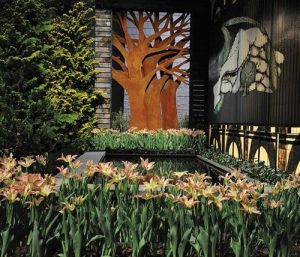
Garden installations at The Philadelphia Flower Show—the granddaddy of them all—were viewed by about 250,000 visitors.Photo courtesy of The Philadelphia Flower Show/Pennsylvania Horticultural Society
The “Garden of Weeping Wonder” was designed and built by grower Rich’s Foxwillow Pines Nursery. Rich Eyre, who co-owns and operates the business with his wife, Sue, says he’s been exhibiting at the show for more than 20 years, and continues to do so because “my plants are for ‘real’ gardeners,” those who seek the unusual and understand the value of unique specimens.

Members of the Washington Association of Landscape Professionals created a spectacular garden that evokes the Great Northwest as well as incorporates modern structures.Photo courtesy of Northwest Flower & Garden Show
Let’s consider some numbers. At this year’s Chicago show, which was still open at press time, management predicted 40,000 visitors. The San Francisco Flower & Garden Show averages about 60,000 visitors. Up in Seattle, the Northwest Flower & Garden Show brings in 75,000 visitors. And this year’s Philadelphia Flower Show, considered the granddaddy of them all, lured 250,000 people to roam the gardens. That’s an awful lot of gardeners, and that’s an awful lot of pocketbooks.

Here’s another thought: If you don’t want to undertake such an admittedly large project on your own, collaborate with colleagues. Or sign on to make a presentation. Seminars are usually packed with eager consumers who are looking for advice and can’t wait for the season to begin. You might even get paid to be a speaker. Can’t beat that.
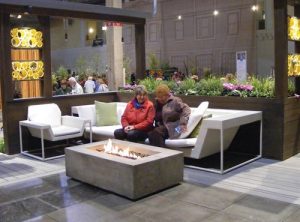
Visitors from Germany relax in front of a gas-fueled fire feature, part of a garden installation designed to educate the public about what goes on underground. The shiny path (at lower left) leading to the fire pit is covered with Plexiglas and allows visitors to see the “underground” gas line. Outside the structure, signage illustrates required distances between plantings and utility lines. The installation was designed and built by Christy Webber Landscapes.Photo courtesy of Sally Benson
Take a stroll through some of the gardens presented here, and start making plans for next year’s crop of shows. You just might find a little inspiration.

The installation titled “Tiny House, Big (Little) Garden” illustrates the potential of living large in the tiny house movement. The just-enough-room structure contains sitting room, dining room, kitchen, bedroom, bath and porch—all with hidden storage—while the much larger outdoor space is dominated by ornamental and food-producing garden, as well as a play area for children. Design and construction was achieved admirably by horticulture students at the Chicago High School for Agricultural Sciences.Photos courtesy of Sally Benson
The post SHOWING OFF appeared first on AmeriNursery.com.
]]>The post REDESIGNED SURVEY REVEALS LATEST RESIDENTIAL LANDSCAPE DESIGN TRENDS appeared first on AmeriNursery.com.
]]>Sustainable and low-maintenance design are the top trends for residential landscape projects, according to the 2015 Residential Landscape Architecture Trends Survey conducted by the American Society of Landscape Architects (ASLA).
Landscape architects were asked to rate the expected popularity of a variety of residential outdoor design elements in 2015. The survey was fielded February 13 through February 27, 2015, with 581 responding. ASLA redesigned the survey for 2015 and introduced a new methodology to more clearly rank the popularity of different types of landscape projects.
Respondents expected the greatest demand for ecologically sensitive projects intended to preserve the environment, conserve water and reduce landscape maintenance.
Here are the top ten project types with the expected highest consumer demand:
- Native plants (85 percent)
- Native/adapted drought-tolerant plants (83 percent)
- Food/vegetable gardens (79 percent)
- Fire pits/fireplaces (78 percent)
- Low-maintenance landscapes (78 percent)
- Permeable paving (77 percent)
- Drip/water-efficient irrigation (74 percent)
- Rain gardens (74 percent)
- Lighting (72 percent)
- Rainwater/graywater harvesting (71 percent)
“Consumers care about designed landscapes that are attractive, easy to take care of and eco-friendly,” says Nancy Somerville, Hon. ASLA, executive vice president and CEO of ASLA. “The survey shows that homeowners increasingly see opportunities to improve the environment right in their own backyard.”
The top three most popular outdoor design elements include fire pits/fireplaces (78 percent), lighting (72 percent) and grills (63 percent). The top landscape and garden elements include native plants (85 percent), food and vegetable gardens (79 percent) and low-maintenance landscapes (78 percent). Pergolas (51 percent), decks (45 percent) and fencing (42 percent) are expected to be the most popular outdoor structures.
The hottest sustainable design elements include native/adapted drought-tolerant plants (83 percent), permeable paving (77 percent) and drip/water-efficient irrigation (74 percent).
Forty percent of respondents noted that the most popular outdoor recreation amenities for 2015 will include spa features—hot tubs, Jacuzzis, whirlpools, and indoor/outdoor saunas—and swimming pools.
For more landscape ideas for your home, and to find a professional in your area, click here.
Outdoor Design Elements
Ranked in expected order of popularity for 2015
Fire pits/fireplaces – 78.0%
Lighting – 72.0%
Grills – 63.0%
Outdoor furniture – 63.0%
Seating/dining areas – 63.0%
Wireless/internet connectivity – 60.0%
Planters, sculptures, garden accessories – 55.0%
Counter space – 53.0%
Outdoor heaters – 46.0%
Stereo systems – 45.0%
Movie/TV/video theaters – 38.0%
Utility storage – 38.0%
Sinks – 37.0%
Refrigerators – 35.0%
Outdoor cooling systems (including fans) – 29.0%
Showers/baths – 27.0%
Hammocks – 20.0%
Bedrooms/sleeping spaces – 9.0%
Outdoor Recreation Amenities
Ranked in expected order of popularity for 2015
Spa features (hot tubs, Jacuzzis, whirlpools, indoor/outdoor saunas) – 40.0%
Swimming pools – 40.0%
Sports courts (tennis, bocce, etc.) – 36.0%
Landscape/Garden Elements
Ranked in expected order of popularity for 2015
Native plants – 85.0%
Food/vegetable gardens (including orchards, vineyards, etc.) – 79.0%
Low-maintenance landscapes – 78.0%
Rain gardens – 74.0%
Water-saving xeriscape or dry gardens – 71.0%
Organic gardens – 68.0%
Plant walls/vertical gardens – 61.0%
Decorative water elements (ornamental pools, fountains, splash pools, waterfalls, grottos, water runnels or bubblers) – 57.0%
Rooftop gardens – 56.0%
Ponds/streams – 33.0%
Outdoor Structures
Ranked in expected order of popularity for 2015
Pergolas – 51.0%
Decks – 45.0%
Fencing – 42.0%
Arbors – 41.0%
Porches – 38.0%
ADA accessible structures (ramps, bars, shelving, etc.) – 31.0%
Pavilions – 31.0%
Utility sheds (tool sheds, garden sheds) – 29.0%
Play structures (treehouses, swing sets, etc.) – 25.0%
Gazebos – 19.0%
Sustainable Elements
Ranked in expected order of popularity for 2015
Native/adapted drought tolerant plants – 83.0%
Permeable paving – 77.0%
Drip/water-efficient irrigation – 74.0%
Rainwater/graywater harvesting – 71.0%
Reduced lawn area – 69.0%
Recycled materials – 65.0%
Solar-powered lights – 55.0%
Compost bins – 51.0%
Geothermal heated pools – 21.0%
The post REDESIGNED SURVEY REVEALS LATEST RESIDENTIAL LANDSCAPE DESIGN TRENDS appeared first on AmeriNursery.com.
]]>