The post ASLA Reports Top 10 Projects with “Expected Highest Consumer Demand” appeared first on AmeriNursery.com.
]]>
Going native, going high tech. That doesn’t make much sense, does it? But according to the most recent customer preference survey conducted by the American Society of Landscape Architects, that’s what customers want.
According to the ASLA, “Customers prefer sustainable — yet tech-friendly — design elements for their outdoor living spaces. … For the first time, wireless/Internet connectivity entered the top 10 project types, suggesting that people want a back yard that allows them to enjoy both nature and connectivity.”
Here are the Top 10 project types with the “expected highest consumer demand”:
- Native/adapted drought tolerant plants – 82.31 percent
- Native plants – 81.60 percent
- Low-maintenance landscapes – 79.25 percent
- Food/vegetable gardens (including orchards, vineyards, etc.) – 76.52 percent
- Permeable paving – 76.31 percent
- Reduced lawn area – 72.66 percent
- Fire pits/fireplaces – 71.51 percent
- Drip/water-efficient irrigation – 71.05 percent
- Wireless/internet connectivity – 70.77 percent
- Rainwater/graywater harvesting – 70.32 percent
Seems “connectivity” has a couple of meanings. Homeowners want to connect with nature – topping the list are not only plants, but natives or adapted plants that require less water. And homeowners want to connect with the vast universe that is the Web.
“The fact that more consumers want outdoor wireless access shows that they want expanded options for remaining connected to their devices,” said Nancy C. Somerville, Hon. ASLA, executive vice president and CEO of ASLA.
“Well-designed residential landscapes provide social interaction, enjoyment of nature and physical activity, while also reducing water use and stormwater runoff,” said Somerville.
Sounds a little like having your cake and eating it, too. But outdoor kitchens didn’t rank highly in this survey.
Consumer requests were broken down further among a number of categories, and the three most requested outdoor design elements are fire pits/fireplaces, wireless/Internet connectivity and lighting.
No. 1 among the most desired landscape and garden elements is native plants. Low maintenance landscapes and food/vegetable gardens follow closely. Next?
- Rain gardens
- Organic gardens
- Water-saving xeriscape or dry gardens
- Plant walls/vertical gardens
- Rooftop gardens
- Decorative water elements (ornamental pools, fountains, splash pools, waterfalls, grottos, water runnels or bubblers)
- Ponds/streams
The most popular elements of sustainable design are native/adapted drought tolerant plants, followed by permeable paving and reduced lawn area. Water-efficient irrigation, rainwater harvesting, recycled materials, solar-powered lighting, compost bins and geothermal heated pools also seem to be popular.
Wouldn’t it be nice if connecting with nature meant leaving behind the other distractions? Some of us would think so. But if the new “connectivity” means that more homeowners and more generations are connecting – in whatever way they’re comfortable – then by all means, let’s embrace it.
The post ASLA Reports Top 10 Projects with “Expected Highest Consumer Demand” appeared first on AmeriNursery.com.
]]>The post 7 Landscape Trends for 2017 appeared first on AmeriNursery.com.
]]>
At the beginning of each year, we can rely on a few evergreen events: resolutions to lose weight or save money; predictions of celebrity weddings and/or breakups; and lists of trends. It’s the trends we care about here, especially as they pertain to the green industry. Do you really care that W magazine has predicted bows, stripes and “a voluminous architectural shoulder and sleeve” to be the going things in 2017? Thought not.
So, from the National Association of Landscape Professionals, we have the following trends to a) look forward to; b) participate in; and/or c) drive to help create an ever more vibrant and growing industry.
1. Going green with all types of greenery. Vibrant green will take center stage in landscapes this year. Combining greenery of various textures and shades, such as a formal hedge of green velvet boxwood, a border of green lilyturf and dense Boston ivy-covered trellises, is just as impactful as a garden filled with a rainbow of colorful flowers. Don’t forget that Pantone has deemed “Greenery” its Color of the Year.
2. Bringing “hygge” outdoors. C’mon. Seriously? To those of us who were raised by Scandihoovians, this is simply a lifelong thing, not a trend. (Someday I’ll pronounce it for you.) But according to the NALP, homeowners have become more interested in holistic landscapes that promote well-being. The Danish concept of hygge is all about creating an atmosphere of coziness by embracing the simple pleasures of life. Decorating with light, arranging seating for close-knit conversation, planting aromatic flowers and adding water features to encourage mindfulness are a few ways to integrate hygge into landscapes, and to find more enjoyment and fulfillment in outdoor spaces.
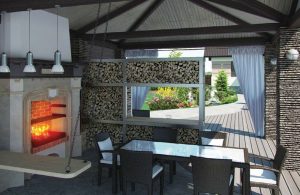
3. Creating tech-savvy exterior kitchens. With the outdoor living trend here to stay, more homeowners are investing in exterior kitchens than in years past. Well beyond basic grilling stations and dining sets, these full-scale kitchens marry the enjoyment of the great outdoors with indoor conveniences. Today’s outdoor kitchens can be equipped with “smart home” technology – for example, built-in consoles on refrigerator doors, mobile app-controlled LED lighting and ovens integrated with Wi-Fi. For an exercise in contradiction, see No. 2, above. (Plus, see the comments in this issue’s profile [page 16] to read a different take on this.)
4. Mixing up materials. Anything but uniform, more landscapes in 2017 will feature the integration of several forms of hardscape materials. From pebble paths bookended with stone planters to wooden decks adorned with iron gates and railings, smart pairings of materials can create a less formal and more playful approach to landscapes.
5. Prioritizing pollinators. Increased attention on the importance of pollinators to our ecosystem has inspired homeowners to develop gardens that specifically attract vital honeybees, hummingbirds and butterflies. More homeowners are asking landscape professionals how to select native plantings that are abundant, year-round nectar sources throughout their yards.
6. Growing “smart” lawns. Through selective breeding of plants, turfgrass seed producers have made significant advancements in developing cultivated grass varieties that are designed to be smarter. They can better withstand the elements while still delivering an aesthetically beautiful and healthy lawn, making them especially desirable in drought-prone areas.
7. Taking landscapes to new heights – and unusual places. The commercial landscape industry first pioneered “green roofs” atop city skyscrapers. Now, we’re seeing green roofs and living gardens in unexpected settings, such as ballpark restaurants or even double-decker buses. Homeowners are thinking above the ground level when it comes to their landscapes, too.
The post 7 Landscape Trends for 2017 appeared first on AmeriNursery.com.
]]>The post Introducing the New Plants of 2017 appeared first on AmeriNursery.com.
]]>new plants 2016
Photo: iStock
Each December, American Nurseryman features an entire magazine dedicated to the latest plants being introduced during the upcoming new year. Follow along as we introduce new plants every day until December 25 and be sure to follow American Nurseryman on Facebook and Twitter for #25DaysOfPlants.
“A generation goes, and a generation comes, but the earth remains forever. The sun rises, and the sun goes down, and hastens to the place where it rises … What has been is what will be, and what has been done is what will be done, and there is nothing new under the sun.”
Those who remember their Sunday school lessons will recognize those words as select passages from Ecclesiastes and, yes, I had to Google it to get the wording right. And no, I’m not about to go Biblical, but I find the words to be reassuring and encouraging and enlightening, despite myriad other interpretations. I choose to find comfort in the thought of circularity, of eternity, of renewal. There’s an implied recognition of the richness of life, of the value of what is here and what has come before. There’s an implied connection, a common thread that runs from the beginning of time, through all of us and all of the physical world, past what is now and on to what will be.
Nothing new? Really? There are those, of course, who would argue that the past few decades have witnessed innovations never before imagined, and they would be right. The same was said of the Industrial Revolution. And that’s right.
But I’m not talking about inventions, about machines, about tools and implements. I’m talking about the living, breathing world. Is there really nothing new? I think we’d be hard-pressed to define that.
This industry, more than most, seeks to improve upon the natural world. So when we say “new,” as in new plants, what we really mean is improved. We’re not inventing plant life; we’re finding ways to study and tweak and fiddle and alter and tickle that one particular cell that means brighter color, renewed fragrance, improved disease resistance. More compact habit, greater fruit yield, robust tolerance of drought. Better. Not a brand, spanking new plant, but a better one.
What an awesome accomplishment this is (and I mean “awesome” in the literal sense of the word, thank you). What an exceptional feat, to take what has been done and make it what will be done. To take the miracle of a plant and to improve upon it. To provide the world with a newer version of this natural phenomenon.
Ecclesiastes, again: “Is there a thing of which it is said, ‘See, this is new’? It has been already in the ages before us.”
Indeed. But dedicated plant breeders (and fiddlers and ticklers) have taken those treasures – those plants that have been already in the ages before us – and have found ways to present “new” forms. In doing so, they provide us all with a glorious celebration of what’s possible.
Isn’t it grand?
The post Introducing the New Plants of 2017 appeared first on AmeriNursery.com.
]]>The post LOOKING UP appeared first on AmeriNursery.com.
]]>Good news on the home front (always wanted to say that!): Existing- home sales “bounced back” in December, 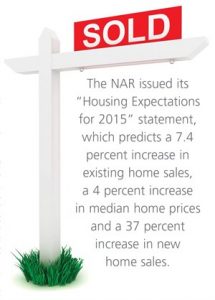 according to the National Association of Realtors (NAR), causing the rate of sales to climb above an annual pace of five million sales for the sixth time in seven months. There had been a slight dip in November, which is not entirely surprising: Not many people think about househunting on Black Friday, when there are blockbuster bargains to be had at Target. What’s worthy of pointing out, however, is that the rate increased in December. It’s cold in at least half of the country, and it’s the holiday season. But let’s not question a good thing.
Comparing the numbers for 2014 with those for 2013, we see there was a slight decline. Hmmm. The NAR says, “Median home prices for 2014 rose to their highest level since 2007, but total sales fell 3.1 percent from 2013.” Let’s concentrate on the clause that says, “… highest level since 2007 … .”
And let’s listen as the NAR further states, “Total existing-home sales … rose 2.4 percent to a seasonally adjusted annual rate of 5.04 million in December from a downwardly- revised 4.92 million in November. From a year ago, December sales were higher by 3.5 percent and are now above year-over-year levels for the third straight month.”
The NAR goes further and predicts that 2015 will see an increase in existing-home sales, by about 7 percent over 2014. The reason? “A strengthening economy, solid job gains and a healthy increase in home prices,” according to NAR Chief Economist Lawrence Yun. An anticipated rise in interest rates may temper the acceleration; still, growth is expected.
In fact, the NAR issued its “Housing Expectations for 2015” statement, which predicts a 7.4 percent increase in existing home sales, a 4 percent increase in median home prices and a 37 percent increase in new home sales. That’s a telling number: Where increasing home sales as a whole may be a positive sign, a significant increase in new home sales bodes well for the green industry.
There are roadblocks, of course, and a few of those include rising mortgage rates and constraints for first-time home buyers. Those first-time buyers are probably the proud new homeowners who’ll need a lot of help with their landscapes. But look at it this way: Those older buyers, who already know the value of the landscape that surrounds their domicile, need help, too. Their knees are aching. Their backs are giving out. I know: I’ve got the orthopedist’s bills to show for it.
It’s tempting to play with statistics, to skew them whichever way you’d like. And there are some caveats to reading the numbers, as in, let’s not get a case of the whoopies because we like what we read. But all in all, the prognosis for the housing market seems to be looking up.

The post LOOKING UP appeared first on AmeriNursery.com.
]]>